
Cutaneous Myiasis in children
Cutaneous myiasis is skin infestation by the larvae (maggots) of certain fly species.
Types of Cutaneous Myasis
There are three main types of skin infestation by fly larvae:Furuncular (pimple-like or boil-like) myiasis, wound myiasis, and migratory myiasis. The disorders vary depending on the species of fly involved.
Where do they occur?
These infestations usually occur in tropical countries. Simply stated, larvae, which are the immature, maggot-form of insects develop inside the skin of human beings wrongfully. Because larvae require oxygen, blocking the skin opening may cause them to leave or at least come closer to the surface. When they are closer to the surface, it is easier to pull them out. To block the skin opening, some people apply petroleum jelly, nail polish, or even bacon or a paste of tobacco. Larvae that die before being removed are harder to get out and often cause an intense inflammatory reaction which is a severe response by the body’s defense mechanism to remove the dead larvae.

Sometimes doctors inject an anesthetic into the skin, make a small incision, and pull the larva out with forceps. The drug ivermectin, given by mouth or applied to the skin, also may kill the larva or cause it to leave.
Symptoms of Furuncular Myasis
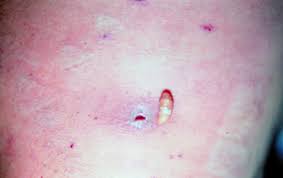
Typical symptoms of furuncular myiasis include itching, a sensation of movement, and sometimes sharp, stabbing pain. At first, people have a small red bump that may resemble a common insect bite or the beginning of a pimple (furuncle). Later, the bump enlarges, and a small opening may be visible at the center. The opening may drain clear, yellowish fluid, and sometimes a small portion of the end of the larva is visible.
How is it transmitted?
Many of the flies do not lay eggs on humans. Instead, the flies lay their eggs on other insects (such as mosquitoes) or on objects (such as drying laundry) that may come into contact with people’s skin.Eggs hatch into larvae, which burrow into the skin and develop into mature larvae. The mature larvae are up to ½ to 1 inch (about 1.3 to 2.5 centimeters) long, depending on the species. If people are not treated, the larvae eventually emerge from the skin and drop to the ground to continue their life cycle.
Image credits: https://www.pagepress.org/journals/index.php/pr/article/view/pr.2012.e34/5598#content/figure_reference_1






Well addressed.
Thank you
Can a ten year old boy get them
Yes, anyone can get it.