Tetanus in Children

I’m sure you have heard about tetanus especially the vaccine against tetanus; perhaps you have taken one. In this article, you would read about the cause of tetanus, how common it is, the symptoms, the treatment of tetanus and most importantly how to prevent tetanus in children.

What is Tetanus?

Tetanus is a severe neurological disease due to bacterial infection from the bacterium known as Clostridium tetani. This Clostridium tetani often produce spores which easily contaminates dirty wounds and can lead to the disease – tetanus within 14 days.

Tetanus used to be one of those conditions that used to be so feared and common, but thankfully, the incidence of severe tetanus is beginning to reduce, especially in newborns. Thanks to the availability of the tetanus toxoid vaccine which if given to mothers can prevent their newborns from having the often fatal neonatal tetanus.

How common is Tetanus?

Tetanus is still common in low-income countries or districts, where immunization coverage is low and unclean birth practices are common. WHO estimates that in 2018, 25 000 newborns died from neonatal tetanus, 88% reduction from the situation in 2000.

How does one get Tetanus?

The tetanus bacteria produces some toxins which can damage the nerves in the body. This often manifests as involuntary spasms. The involuntary spasms can affect any part of the body. Prolonged spasms can cause further damage to the muscles which can lead to kidney failure, and in severe cases death.

Who can have Tetanus?

People of all ages can get tetanus but the disease is particularly common and serious in newborn babies and their mothers when the mother is unprotected from tetanus by the vaccine, tetanus toxoid. Tetanus occurring during pregnancy or within 6 weeks of the end of pregnancy is called maternal tetanus, while tetanus occurring within the first 28 days of life is called neonatal tetanus. 

Symptoms of Tetanus

Tetanus can be localized meaning it is limited to only one part of the body or it can be generalized affecting multiple organs in the body at the same time. The localised tetanus is usually mild form of tetanus while the generalized one tends to be severe and can be fatal.

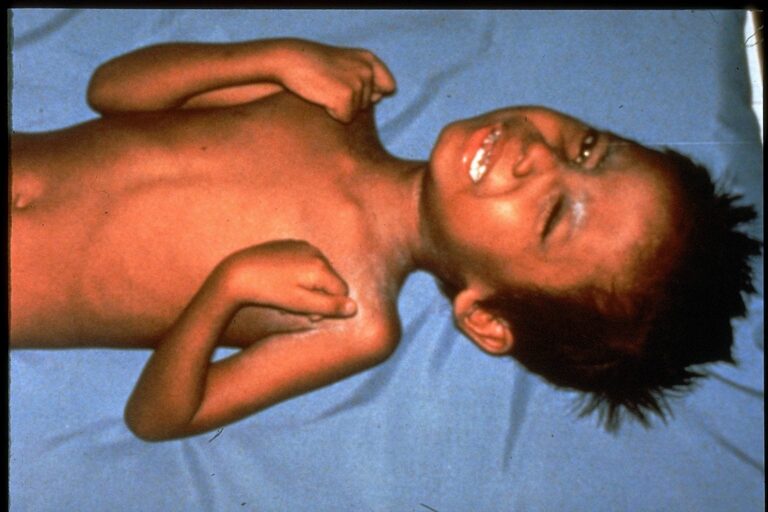
Symptoms of Tetanus also depend on age group. For adults and older children, it may first present as locked jaw where they affected person can not open their mouth. Later, they begin to have muscle spasms. Spasms is the hall-mark symptom of Tetanus in most age groups. It looks like convulsion but can be described as sudden electric shocks which happen repeatedly. The spasms can affect all the muscles in the body.

Usually the child is conscious during these episodes of muscle spasms which are usually very painful. This muscle spasms can occur in any part of the body including the arms, legs, abdomen. The spasms tends to be triggered by things like noise, sudden movements and light.

Other symptoms of tetanus include difficulty in swallowing, headaches, fever, excessive sweating and convulsion (different from the spasm). The toxins can also affect others nerves in the nervous system known as the autonomic nervous system that regulate heart rate, blood pressure and breathing. This can lead to some patients with Tetanus ending up in Intensive care unit if very severe.

Symptoms of tetanus in babies usually start with refusal to suck. The babies with neonatal tetanus are usually irritable, crying before they start having the spasms.

Diagnosis of Tetanus

Most times, once the spasms occur it is very easy to make a diagnosis of tetanus. Tetanus is one of the easiest clinical diagnosis to make because the spasms are so peculiar to tetanus. In addition one can often easily spot the entry wound for the tetanus. In children, the wound is usually seen. Other sources of tetanus infections especially babies include the umbilical cord if covered with cow dung or cut with unsterilised and contaminated instruments. Chronic ear infection with pus can also be a source of the infection.

How is Tetanus treated?

Treatment of Tetanus involves

  • neutralizing the toxin
  • getting rid of the bacteria
  • symptomatic relief of the spasms
  • treating any other complications

Doctors neutralize the tetanus toxins using human tetanus immunoglobulin. Previously, we were using the horse ones antitetanus serum but now Human ones are being used which are safer. The immunoglobulin neutralize the toxins before they bind to the nerves and cause spasms.

Additionally, we get rid of the source of the tetanus bacteria spores by treating the wound, infected umbilical cord and ear infection. This may involve cleaning them out especially removal of dead tissues and by giving antibiotics treatment that the tetanus bacterium is sensitive to.

The spasms are managed by using medications that can relax the muscles.The most painful part of the tetanus is the muscle spasms which are painful, so muscle relaxant e.g. diazepam (valium) are given every four hours, frequently, in drip and bolus, to reduce the spasm and relax the muscles. Other symptomatic treatment are also necessary and in some cases may require ICU care.

Prevention of Tetanus

The most important and the best part is Tetanus is preventable. No child need to experience tetanus is one of the vaccine preventable disease. We have an effective vaccine against tetanus – the tetanus toxoid vaccine (TT)

In newborns, mothers have important role in preventing tetanus by ensuring that they are fully immunized against tetanus during pregnancy. There are five doses of the TT vaccine that all women of child-bearing age should take especially if living in areas where there clean deliveries supervised in hospital are not universal. See the timetable below

The main reason for immunizing the mothers is primarily because of the babies, even though the mother is also immunized. If a mother is immunized, her baby will be immunized.

In addition to immunization, mothers should ensure they deliver their baby in a standard hospital where deliveries take place in clean environment and sterilized instruments are used to cut the cord. Traditional birth centers often do not ensure such details.

Cord care is also important in preventing tetanus in the newborns. The navel is usually the entry point for tetanus in newborns. Cord care should be done by applying chlorhexidine gel once a day or using 70% methylated spirit every four hours to clean the cord. the navel should be exposed to air and not covered with bandages or nappies. Things like dusting powder, toothpaste, cow dung, mentholated balm and heat (wet or dry) should not be applied to the navel. Advantage of chlorhexidine gel is that mothers can just apply once a day for seven days, which is less stressful yet sufficient to protect the child from bacteria infection of the navel including that of tetanus bacteria. Where no gel is available, methylated spirit is fine but requires frequent cleaning every 4 hour. The cord care should continue the navel is fully healed. .

For older children, the main prevention from tetanus is routine immunizations. Tetanus toxoid vaccine is part of the routine immunizations given as part of the pentavalent vaccine (five in one vaccine) given at 6, 10, and 14 weeks. These three doses protect the children against tetanus until age 18 months. Then booster doses should be given at 18 months, 5, and 10 years because the initial protection tend to wane with time. Each time a child has a major injury or wound including burns; it is also prudent to give a booster dose of tetanus toxoid even though the child is fully immunized.

It is also important that the tetanus toxoid vaccine taken is well-kept to avoid break of the cold chain. Do not take the vaccine in just any clinic or hospital, as some facilities do not preserve their vaccines well due to lack of facilities and equipment to keep the tetanus vaccines in a cold environment, Hence government facilities are the best to go to for immunizations including that of tetanus toxoid as they always ensure the cold chain is not broken.

I hope you have learnt a lot about Tetanus. Feel free to ask your questions in the comments section or on our Facebook group. More importantly, ensure you and your children are fully immunized and protected against Tetanus.

Basic Skin Care for Infants and Children (1)

Dr Folakemi Adeife Cole, Consultant Dermatologist on the Ask The Paediatricians Facebook Group handled a group discussion recently on the topic of the care of skin for newborns and children. The salient points have been summarised into two-part articles. This is the first article and essential for all parents.

Basic skin care starts from the moment a child is born. Good skin care practices from birth have a major impact on not just a child’s skin but also their general health and wellbeing and I will be sharing with you why.

As soon as a baby is out the womb, they are exposed to the environment which includes the temperature and germs in the environment. It is important that the first germs a baby is exposed to are familiar friendly bacteria of the mother and father and not the unfriendly germs of the hospital. New research has shown that the best thing to do when a child is born is to put the child on the mothers chest to institute skin to skin contact with the mother and the familiar bacteria or normal flora of the mother.

So when a child is born, the doctors and nurses should not rush to wash the child or clean the child first; except the child requires some resuscitation. It is best to put the child in contact with the mothers bare skin, especially children born via caesarean section. Children born via vaginal delivery would have come in contact with the mothers good germs when passing through the vagina. Children born via caesarean section can get some of these good germs from skin to skin contact by laying on the mothers chest for some minutes immediately after birth.

So the first step for good skin care for infants is skin to skin contact with the mother.

Research has shown that babies who do not have this skin to skin contact are more likely to have allergic conditions and skin issues as they grow up.

Then it is important to clean the baby with a good oil like coconut oil immediately after birth and not be in too much of a hurry to bath the baby. The baby’s first bath can be a few hours or even a day after birth.

Please avoid the use of antiseptic soaps and liquids in bathing new born baby or infant of any age. It is a very wrong practice that a lot of our hospitals and midwives encourage but research has shown that it is harmful to the health of the baby.

It is important to bath the child with clean water but not antiseptic water because the antiseptics like dettol and savlon are irritants to the skin and they also take away to good bacteria on the baby’s skin which can cause immune dysfunction in the child.  The immune system is supposed to mature and develop with exposure to normal environmental germs. When you prevent such exposure, the immune system can become overreactive and that’s why many children nowadays have allergies and all manner of skin rashes problems.

Please avoid medicated soaps and liquids for your babies, infants and children.

Look for pH balanced soaps and cleansers for babies. Examples include sebamed baby wash, dove baby wash, aveeno baby wash. These are close to the normal acidity level of a healthy skin and will encourage the baby’s skin to be healthy. Original black soap is also quite good but many people who now make black soap have changed the formula, making it quite harsh on the skin.

You can ensure the water you bath your baby with is clean by boiling it with a boiling ring if you do not have a water heater . If you have a water heater run the water for the bath hot and allow it to cool down and use it to bath the baby. Hot water will be free of germs like bacteria, viruses and fungi that can harm your baby.

Use good moisturizers – lotions, creams and oils for your baby.

Do not use harsh sponges to scrub the baby’s skin. Use gentle soft sponges. Scrubbing the skin too much can damage the child’s skin by removing some good oil that the skin produces.

Avoid triple action creams like Funbact A and Skineal!

They are a big NO for babies and children. They contain very strong steroids that should not be used in any child less than 12 years. the skin of a baby is very thim and the substances in these creams can easily be absorbed into the baby’s blood through the skin and cause some damage to the child’s vital organs!!! Avoid all creams that say anti inflammatory, antibacterial anti fungal (aka triple action creams). They are harmful to babies!

To Be Continued…….in Part 2!

INFECTIONS IN THE NEWBORNS (2)

In the first part of this article on newborn infections, we address the common risk factors for infections in newborns. If you have not read it, you can do so here!

This is the concluding part we will look at how to know when a newborn has infections, what to do and how to prevent newborn infections.

How do you know if a newborn baby has infections?

Newborns when sick with infections often may not have any specific signs that most parents are used too when the older children have infections. Sometimes, the baby may just appear dull or not as active as before. Other times, they may actually show other signs of infections like:

  •  Fever
  • Refusing to suck
  • Crying excessively or inconsolably even when given breast
  • Eye discharge
  • Smelly or discharge from umbilical cord
  • Weak or limp baby
  • Boils or tiny swellings containing water or or pus on skin
  • Jerking /shaking body( hands , legs etc)

If you think your newborn has infections or is showing any of the above signs, that is not the time to wear your “Home Doctor” hat!!!

Newborns are so fragile and illness in them can progress so fast and can lead to unwanted consequences we already mentioned.

A sick newborn can only be treated by the doctor, preferably a Paediatrician at the Hospital!!

If you observed any of these signs, please go to the hospital without delay!!!

ANY BABY WITH ANY SIGN OF INFECTION LISTED ABOVE SHOULD BE TAKEN TO HOSPITAL IMMEDIATELY!!! (We can not emphasize this enough).

Delay in seeking help promptly can lead to fatal consequence!

Prevention of newborn infections
As we can see, once infections occur in the newborn baby, it is beyond your control as parents. At that point, it is the Paediatricians and God that are in charge.

However, there is a lot we can do to avoid or prevent newborn infections. Prevention as we are often fond of saying is always better, cheaper, less painful than in the newborn.

Prevention of newborn infections can be achieved substantially by observing the following

  • Good antenatal care – register early and standard centres/hospitals
  • Early/ proper treatment of urinary tract infection or any infection in mother
  • Delivery in a proper setting: good clean environment
  • Delivery by qualified or trained healthcare professionals
  • Any woman who ruptures membrane ie breaks her water must go to the hospital – Ideally, she should be started on antibiotic if the delivery is taking longer than expected
  • Use of sterile (clean) equipment to cut the umbilical cord.
  • Do not apply any of the materials mentioned earlier on the umbilical cord. Accepted treatment for cord care is CHLORHEXIDINE GEL! Apply it once daily for seven days or till the cord has dropped and healed. Where this not available good quality methylated spirit to clean every 2hour
  • Do not give Ampiclox syrup or drops to your baby after delivery.
  • Avoid the “ajogba” mentality! A baby who has infection will not respond to Ampiclox!!! It cannot treat it and this will delay the commencement of the right and appropriate treatment. This can lead to fatal consequence! If you deliver in a clean environment, with none of the risk factors for infection mentioned earlier, you do not need to give the newborn Ampiclox. We know this is a very rampant practice especially in Nigeria but it is wrong. It only gives mothers a false sense of protection and may mask the signs of newborn infections when it actually occur; which may lead to late presentation and treatment with attendant danger of newborn death.

In conclusion, infections in the newborn can cause unnecessary deaths if not treated promptly. The good news is that most can be prevented by adopting simple strategies we already discussed.

Should infections still occur despite all efforts, please do not do home treatment, go to the hospital immediately as DELAY IS VERY, VERY DANGEROUS!

Thank you for reading. Keep being informed to keep our children healthy. I look forward to your questions and comments.


INFECTIONS IN THE NEWBORNS (Part 1)

The birth of a newborn baby is always a thing of joy!

As paediatricians, we are privileged to share the joy with the new parents and their families.

Sometimes, however, we often have to share their pains as well if things go wrong. One of the things that can go wrong is the baby developing infections.

Infections in the newborn or what we call Neonatal Sepsis in medical jargon is one of the leading causes of deaths in the newborns.

In places like Nigeria and generally in the developing countries of the world, we tend to have a high rate of newborn deaths as high as 50 for every 1000 newborns.

That is disastrous compared to developed countries with figures in single digits. To make sure our babies live and survive, we must prevent newborn infections and treat promptly if/when they occur.

This post is based on our online Ask the Paediatricians Facebook Group Discussion by a Consultant Paediatrician and Neonatologist, Dr Patricia Akintan on infections in the newborns.

It addresses this very important topic with emphasis on our roles as parents and caregivers.

Who is a newborn (neonate)?
A newborn is a baby less than 28 days old. Newborns are prone to infection because they have a poor body defence. Infections in the newborn can occur during pregnancy, during delivery and after delivery.

Common infections in newborn

  • Infection of eyes: pus or discharge from eye

  • Boil or pus containing swelling on the body
  • Infection in the blood (sepsis)
  • Neonatal Tetanus
  • Meningitis (infection of the brain)

What are the factors that can lead to infections in newborn?

These are important to know because most of the preventive strategies will be directed at these factors. These can be either from the mother, events that occur during the time of delivery or after the delivery

Factors in mother

  • Fever in mother around time of delivery
  • Painful urine in mother or mother passing urine frequently – this can be a sign of urinary tract infection in mother which she can pass to baby
  • Rupture of membrane; if mother breaks her water long before baby is delivered
  • Vaginal discharge in mother before delivery
  • Some infections in mother e.g HIV can be passed on to the baby if mum not on treatment

Factors during delivery

  • Dirty delivery area
  • Using Unclean hands to deliver baby
  • Unclean or dirty cloth use to receive or clean babies skin baby
  • Delivering babies on the floor
  • Unsterile (unclean) instruments like scissors blade etc

Factors after delivery

NOTE: The cord is the easiest route of infection.

  • Poor care of the umbilical cord like the use of dirty rope or thread to tie cord.
  • Use of cow dung to treat umbilical cord
  • Also the use of  toothpaste, Robb, mentholatum, alabukun, aboniki on the umbilical cord
  • The use of charcoal or lantern Not cleaning cord well or regularly
  • Poor skin care: Touching baby’s skin with dirty hands
  • Allowing everybody to carry baby without washing hands
  • Giving baby water or native concoction “Agbo” can cause diarrhoea
  • Putting breast milk in eyes can cause an eye infection.

In the next part, we will discuss how to recognize symptoms of infections in the newborn, what to do and more importantly HOW TO PREVENT INFECTIONS in the newborns.

Keep reading and sharing this article. Together we can reduce the unnecessary deaths of our newborns.

If you have questions, drop it in the comments section or email me at dr*********@******************ns.com.