WHAT YOU NEED TO KNOW ABOUT MALNUTRITION!

Malnutrition is  a global issue but more common and devastating in developing nations where it is underlying and contributory to more than 50% of deaths of in children below the age of 5 years. It affects growth, development, immunity and learning abilities of children.

Dr Nwaoma Nwaogu, Consultant Paediatrician discussed this topic in one of our ATP group discussions recently which has now been summarized into this article.

Malnutrition, simply put, is lack of proper nutrition.

WHO refers to it as deficiencies, excesses or imbalances in a person’s intake of energy and or nutrients. There are different forms of malnutrition

  • Macronutrient deficiencies e.g. protein, carbohydrates,
  • Micronutrients e.g. vitamins, zinc iron deficiencies
  • Overweight and obesity is a form of malnutrition.

What are the common causes of malnutrition?

These can be grouped into three main categories:

  • inadequate intake
  • increased loss
  • factors external to the child.

Inadequate intake:

  • Food unavailability
  • Inadequate quantities
  • Food taboos
  • Ill health from any reason can contribute to inadequate intake of food.

Increased loss

  • Chronic or recurrent diarrhoea.
  • Problems with digestion and absorption of food already eaten can lead to loss of nutrients too.
  • Infections e.g. TB, Measles
  • Infestation e.g. hookworm infestations
  • Chronic conditions that affect appetite and metabolic processes in a child. e.g. sickle cell anaemia, congenital heart disease etc

Social contributors

  • Poor sanitation/hygiene and dirty environment which call provide the conducive atmosphere for infection to thrive
  • Uneducated mother
  • Teenage mother
  • Ignorant mother
  • Absentee mother e.g. a mother with mental ill health

Symptoms and signs of Malnutrition

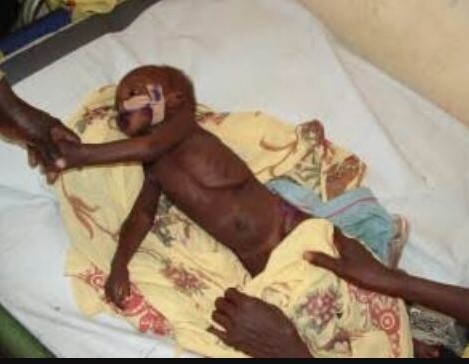
The tell-tale signs of severe malnutrition include :

  • Head: thin hair, discoloured hair, sparse and brittle hair, prominent bones
  • Face: prominent bones, pale conjunctiva, oral lesions/ mouth sores
  • Skin: hanging skin, rashes/lesions, wounds that won’t heal
  • Limbs: thin bones and sometimes, swollen limbs; what we call oedema.

However children may have mild form of malnutrition with other subtle signs:

  1. Weight and height that are low for age of the child.
  2. Skin signs
  3. Bow legs
  4. Clothing becoming loose
  5. Child always tired/fatigued
  6. Hair  and nail changes

Management of a child with malnutrition should be at the hospital by a Paediatrician and Nutritionist (Dietitian)

Prevention of Malnutrition

  1. Exclusive breastfeeding for the first 6 months of life and adequate complementary diet beyond 6 months. This entails giving the right balance of nutrients in the right quantity, right texture/consistency, right frequency and right density/volume. You should read the article INFANT FEEDING IN THE FIRST 1000 DAYS for more information on this.
  2. Immunizations – this fight all diseases that are vaccine preventable.
  3. Personal and environmental hygiene. Hand washing and proper handling of sewage and other household waste including proper waste disposal. You should wash your hands with every diaper change; before making the child’s food and afterwards.
  4. Health Education: this article is based on parents health discussion handled by our Paediatrician on Ask The Paediatricians Facebook group. It is important to learn more about child health issues on such platforms and websites like this. You should also spread the right information. What are the available local food options? What fruits are in season, do you know how to prepare ORS and administer to a child with watery stools? All these we must learn and teach others.
  5. Family planning: You should space your children and have the number of children you can cater for properly.
  6. Clean water: It is important to make sure the child drinking water is boiled or sterilised using appropriate agents e.g. water guard
  7. Proper antenatal care: A malnourished mother will produce a malnourished low birth weight infants

If you are concerned about malnutrition in your child, please see a Paediatrician immediately. If you have any questions, you can ask in the comments. For urgent questions, this can be asked in our Facebook community group from Mondays to Saturdays. Remember to follow us on all our social media handles and join us every Monday at 6pm for the Ask The Paediatricians LIVE. Past episodes can be watched on our YouTube channel.

INFANT FEEDING IN THE FIRST 1000 DAYS

Infant feeding especially, in the first 1000 days of a child is very essential!!

Our instincts as moms to nourish, nurture and protect our children from the moment we become aware of their existence actually has a scientific basis.

The first 1,000 days of a child’s life—from pregnancy (270 days) through a child’s 2nd birthday (365 days x 2) serves as a critical window of time that sets the stage for a person’s intellectual development and lifelong health.

It is a period of enormous potential, but also of enormous vulnerability.

Ensuring every child has the right start to life during these precious 1,000 days begins first and foremost with nutrition. The nutrition that children get from the food they eat early in life is a critical building block for the growth of their bodies, the development of their brains, and good immune systems.

Quite simply, there is no other period of a person’s life when nutrition has as profound an impact as in the 1,000 days from a woman’s pregnancy until her child’s 2nd birthday.

Poor nutrition or malnutrition, which can be under-nutrition (hunger) or over-nutrition (obesity) early in life can have long-lasting negative consequence on the child some of which may be irreversible. This is the reason why ensuring good nutrition for the first 1000 days of life is a worthy investment in the well-being of a child.

What does good nutrition in the first 1000 days entails?

Pregnancy period : Maternal nutrition

The pregnant mom must eat healthy, adequate nutritious diet including taking prenatal vitamins especially folic acid which is very important for brain development of the baby in the first trimester of the pregnancy.

0 – 6 months : Exclusive breastfeeding  

  •  As soon as the baby is born and for the next six months of baby’s life, exclusive breastfeeding.
  • That is giving baby only breast milk in the first six months! No water, no formula, no herbal concoction, no medications except if prescribed by the doctor.
  • Breast milk is very good for growth of the baby and also for good brain development. It is the most powerful protection against infection and disease that a child could get not forgetting a host of other benefits for both mom and baby.

6 – 24 months : Complementary feeding

  • From 6 months, breast milk is no longer sufficient. The infant should be introduced to solid foods while continuing breastfeeding on demand.
  • The solid should not just be one class of food for example pap but a mix of all the various classes of food including proteins, fats, vitamins and minerals. This is vital for growth and brain development.
  • To be sure that you are doing the complementary feeds right, the practice must fulfill this acronym: FADUA!
  • F – Frequency
    • The frequency of complimentary feeds given in a day increases with the age of the child. Usually about 2 – 3 times a day in 6 – 9 months, then 4 times per day after 9 months. Remember breastfeeding should still continue till age 2 years while infants are on complementary feeds

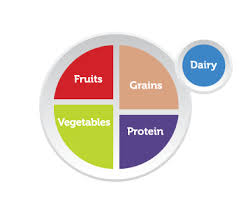
      My Plate Photo credit: Google Image
  • A – Adequate
    • This means adequacy of the food in quantity and quality. It should contain foods from at least four of the six food groups which includes a) grains, roots and tubers b) legumes and nuts c) dairy products (milk, yoghurt, cheese) d) Flesh foods (meat, fish, poultry and liver/organ meats) e) Eggs f) Fruits and vegetables
  • D – Density.
    • This has to do with the consistency and caloric density of the complimentary feed. The consistency should be appropriate for age in order to ensure easy digestion by the infant. Foods with high calorie content are preferred.
  • U – Use of food.
    • This entails use of a variety of foods so as to avoid monotony as infants often get bored with being given the same type of food all the time. It also involves use of hygienic methods of feeding, food preparation and storage. Always give variety and use of plates, cup and spoon! Do not use feeding bottles please.
  •  A –  Active feeding methods.
    • This is also known as responsive feeding and is defined as the process of recognizing baby’s cues for hunger and fullness and responding appropriately to them by either feeding or stopping. Force feeding should not be practiced.

By the end of age 2 years, the child should be on full family diet like the rest of the family. It is important that we get the nutrition in the first 1000 days of life right. Make that worthy investment today!

In subsequent series, we will look at the practical details of feeding and the nutritional disorders and their consequences. Keep reading.