
Help Paed! I have a Child with Special Needs (1)

As a Paediatrician with  subspecialty training in Neuro-developmental Paediatrics, I basically take care of all children health issues especially those with physical and mental disabilities. This group of children are often referred to as Children with special needs.
This is a topic I am particularly passionate about especially in the part of the world where I practice with so much ignorance and superstitious beliefs about this wonderful group of children. This post is to provide you with the basic information you should know either as a parent or caregiver with special needs children
Even if you don’t have a child with special needs, you need this information as well to know how to relate better with children and families with special needs.


Who is a  child with Special Needs?

First every single child is special!
But what do we mean when we say “children with special needs”?
Merriam Webster dictionary defined “special needs” as mental, emotional, or physical problems in a child that require a special setting for education.

⦁ This means any child who might need extra help because of a medical, emotional, or learning problem.
⦁ these children have special needs because they might need medicine, therapy, or extra help in school — things that an average child won’t typically need or only need once awhile.
⦁ Basically, these are children with physical and developmental disabilities

Common medical conditions that predispose children to have special needs:-

  • Cerebral palsy
  • Down Syndrome
  • Autism spectrum disorder
  • Intellectual disability
  • Congenital syndromes
  • Hearing impairment “Deaf”
  • Visual impairment “Blind”
  • Learning Disability – Dyslexia, Dysgraphia,
  • Spina Bifida
  • Hydrocephalus
  • Attention Deficit Hyperactivity Disorder
  • Behaviour disorders – conduct disorders, oppositional defiant disorders.

These disabilities can be mild, moderate or severe. Children with disabilities do not constitute a uniform group, We have are children who are completely independent and at the other end of the spectrum are those who are completely dependent on others for every activity of daily living.

Why does my baby have special needs?

  • Disabilities can begin anytime during the developmental period and usually last throughout a person’s lifetime.
  • Most disabilities begin before a baby is born, although some happen after birth.
  • The causes of disabilities in children are often due to multiple factors some of which the affected families have no control over.
  • Sometimes we simply do not know why the condition happened!

Common Causes

The Causes of disabilities BEFORE birth include:

  • Genetic:– Children with Down Syndrome have an extra chromosome 21. There are many other congenital disabilities that have to do with problems at the level of the Chromosomes or genes, some of these may be inherited conditions; others are not.
  • Infections the mother might have during pregnancy affecting the baby in the womb – popularly called the TORCHES can lead to birth of babies who may later have disabilities such as Cerebral palsy, deafness, blindness.
  • Malformation of the brain, spinal cord and other vital organs causing hydrocephalus, spina bifida.
  • Parental health and behaviors (such as smoking and drinking) during pregnancy can cause Fetal alcohol syndrome.

Causes AFTER birth include;

  • Prematurity – babies born before 37 completed weeks of pregnancies
  • Complications during birth – failure to cry at birth (birth asphyxia), birth injuries (Erb’s palsy).
  • Severe Jaundice
  • Severe infections in the early newborn and infancy period especially involving the brain (meningitis)
  • Exposure of the mother or child to high levels of environmental toxins, such as lead.

Disabilities and Prevention

Disabilities and Prevention

Can it happen again? How do I prevent my child from having this challenge again?
Some forms of disabilities can be prevented by simple measures and these include;

• Folic acid intake by all women of the child bearing age – this prevents the spina bifida, hydrocephalus
• Avoidance of smoking and alcohol consumption by pregnant women
• Early registration and proper antenatal care can prevent early deliveries of preterm babies
• Supervised deliveries by skilled medical professionals and well-equipped centres for emergency obstetric care to prevent birth complications
• Early detection and treatment of some medical diseases in neonatal and infancy period especially jaundice and severe neonatal infections
• Screening for the genetic disorders
• Early presentation to the Hospital and diagnosis and treatment of the disabilities to avoid further worsening of the disability and development of secondary complications


Disabilities: – Myths and Misconceptions

There are so many myths and misconceptions rampant in the African society about children with disabilities. These misconceptions often lead to further societal stigmatization of people with disabilities.
They are also contributory to children with disabilities not achieving their maximum potential.
There is no scientific basis for these myths and misconceptions and they are often rooted in ignorance and superstitious beliefs.
Common myths and misconceptions on disabilities include;

  • Spiritual cause – Most disabilities are not due to spiritual causes as we have stated the causes above. They are not due to demonic afflictions or witchcraft.
  • Disabilities are contagious – Associating or interacting with children with disabilities does not mean the person will also develop disabilities. There is a belief that a pregnant woman who stays around such children will have children with disabilities; that is not true.
  • Society rejects/outcasts – people with disabilities are believed to be unnecessary burden to the society who can never be productive or achieve anything in life. This is responsible for the high rate of physical abandonment and/or neglect of such children. Such children are even killed at times in extreme cases. This is cruel and criminal. Children with disabilities with the right support can live to achieve their maximum potential.

Famous People with Disabilities

Disability is not a death sentence! Children and adults with special needs and disabilities can live good quality lives that can benefit the society despite the challenges they may face.
A brief Google search will reveal many successful people in the world with disabilities ranging from a former US President to many athletes, authors, evangelists in the recent past and contemporary times as well.

This is not limited to the developed world. In Nigeria, we have our own successful people with disabilities. Cobhmas the prolific music producer is blind. Tobiloba Ajayi is a lawyer and CP advocate with cerebral palsy. Many children with special needs have done Nigeria proud by winning gold at the Special Olympics. With advancement in technology are living full and productive lives.

A very inspirational example is Nicholas James “Nick” Vujicic, an Australian Christian evangelist and motivational speaker born with Phocomelia, a rare disorder characterized by the absence of legs and arms. He has written books, married with two children and often speak to thousands of people to motivate them to fulfill their maximum potential.

This is not limited to the developed world. In Nigeria, we have our own successful people with disabilities. Cobhmas the prolific music producer is blind. Tobiloba Ajayi is a lawyer and CP advocate with cerebral palsy. Many children with special needs have done Nigeria proud by winning gold at the Special Olympics. With advancement in technology are living full and productive lives..

Conclusion:

We should all seek to understand children and individuals with disabilities and support them in achieving their maximum potential.
There is always hope and ability in every disability!

Myths about Child Healthcare in Nigeria / Africa – The Good, Bad and Ugly!!!

Hello Everyone!

So we will be sharing some myths we have heard and superstitious beliefs we are use to pertaining to child healthcare in Nigeria. As we know, in this part of the world, her in Africa,Nigeria to be precise we have some ‘laws’ or should say ‘practices’  unorthodox,funny and sometimes ridiculous with no basis and sometimes very  DANGEROUS!  Others can HARMLESS and some can be  BENEFICIAL

I will be sharing few of these myths, in a view to correct some wrong practice and superstitions! You can send your feedback,questions,thoughts using the comment below or send an email to as*@******************ns.com


Dangerous Myths

  • MYTHS: The believe that the cord on a new born must drop before the naming ceremony and applying toothpaste or  ashes on it to forcefully remove it.
    COMMENT: Like every wound in the body, the cord is also a wound. The way our wounds heals differs based on skin type, some 3 days, others longer like 10 days. Cord falling off shouldn’t be a perquisite for naming ceremony. Toothpaste and ashes are dangerous; they provide means of introducing infection to the newborn.
  • MYTHS: As a pregnant mother, when the other older child tags along with you and always lays close to your tummy. He/She will always be ill.
    COMMENTS: False & Dangerous
  • MYTHS: Putting breast milk in your baby eye when is redish or bringing pus.
    COMMENT: Dangerous! PLEASE DO NOT PUT BREAST MILK IN THE EYES…..SEE A DOCTOR
  • MYTHS: giving a baby concoction agbo at early birth,
    COMMENT: I go against all this but mother in law feel *you too know*. DANGEROUS….DO NOT DO IT!!
  • MYTHS: When my second baby came, I was told to bath the first one with  dirty water used by the new baby to bath the first one, so that he will not disturb me and stop crying.
    COMMENT: FALSE AND DANGEROUS…..DO NOT DO IT
  • MYTHS: The belief that if a crawling baby eats his/her poop unknowingly, the mother is suppose to taste from the poop also else something terrible would happen to the child
    COMMENTS: DANGEROUS….RISK OF INFECTIONS BUT YOU AS A MUM TOO SHOULD NOT ALLOW THE BABY TO ALSO EAT POOP NOW!!!
  • MYTHS: That a pregnant woman should not eat grass cutter, because it causes prolong labor,  and in a situation where a woman is having such a labor and it’s being confirmed that she ate grass cutter, the bones of the animal should be brought to her to the hospital
    COMMENT: You need protein while pregnant and if grass cutter is the only source in your area please go ahead and eat
  • MYTHS: Pressing the breast of new born
    COMMENT: Dangerous.… Please DON’T DO IT
  • MYTHS: That a woman who is pregnant must not eat fried plantain to avoid of oka ori in Yoruba.
    COMMENT:  OK this one is FUNNY! You need iron and other nutrients present in the plantain!
  • MYTHS: Putting spoon in d mouth of a convulsing child or onions and palm kernel oil (ude-aku)
    COMMENT:  Please Biko! I beg of you DON’T!…. Read more on the group discussion on convulsion in children
  • MYTHS: When you give birth to a baby, drop coconut water inside the baby’s mouth so that the child to prevent stomach pain. Is this true?
    COMMENT:  False and dangerous.

A mom should never allow her baby fall from her back. Otherwise, the child will only know bad luck.
So many others that I have forgotten

COMMENT: False, but good myth at least for prevention of head injury not necessarily the bad luck part


We will stop here for now, be sure to check back for more updates!
Don’t join the bandwagon, Information is light, keep your kids safe an healthy!

Avoiding Tooth Decay in Children

Welcome to Ask the Paediatrician’s Blog and the focus today is Dental Caries in children.
Many parents are worried about tooth decay even in young children. On the Ask the Paediatricians’ Facebook Group Parents’ Grand Round recently, a Paediatric Dental Surgeon of the Department of Child Dental Health, Lagos University Teaching Hospital, Dr Bukky Olatosi dealt extensively with the issue of Dental Caries in children, the cause, treatment and how to prevent caries. This is a blog post of this important topic. Read, learn and share!


What is Dental caries?

Dental Caries simply means tooth decay. It is caused by specific types of bacteria which produce acids that destroy the tooth.
Normally we have bacteria in our mouth. These bacteria continue to build up on the teeth to form what we call plaque (the yellowish deposit that is seen on the teeth when they are not brushed).
These bacteria turn sugar and carbohydrates (starches) in the foods we eat into acids. These acids dissolve the teeth gradually to eventually form holes Which are too small to be seen at first. But they get larger over time.
This picture describes the role of sugar and bacteria in tooth decay.

Caries seen in children 6 years and younger is called EARLY CHILDHOOD CARIES, it has also been referred to as NURSING CARIES, BABY BOTTLE FED CARIES, COMFORTER CARIES and many other names.
This is how tooth decay progresses.

Google Image: Tooth decay progression

What are the causes of Early childhood caries?

  1. Bacteria: When a baby is born the baby’s mouth is free of bacteria but begins to acquire it as early as 24hours after birth. One of the ways a baby acquires bacteria is by transfer from the mother or caregiver.
    That is why tooth decay is a transmissible disease. Mouth to mouth kissing of a baby, mother/caregiver placing baby’s spoon in their mouths, helping a baby to chew his/her food before placing in the baby’s mouth.

    Google Image: A mother sharing her baby’s spoon

    Also sharing of feeding utensils, saliva sharing activities among children at schools and daycare centers. All these are possible ways of acquiring the bacteria causing tooth decay.

    The mother in this picture is putting her baby’s hand in her mouth
    The mother in this picture is putting her baby’s hand in her mouth


  2. Poor feeding practices: Inappropriate use of feeding bottles, bedtime use of baby bottle containing sweetened drinks. Mothers please note “Do not give your babies feeding bottles containing carbonated drinks, chocolate beverages even milk to sleep”.This picture shows a baby sleeping with bottle containing milk. This type of feeding habit should be avoided.
    Googe Image: A baby sleeping with bottle containing milk

    When an infant falls asleep with a bottle, or uses a bottle or sippy cup for extended periods of time, the sugar can coat the teeth. This causes the teeth to decay more quickly in such children. If you must give your child a bottle, fill it with water only. Teach your child how to drink from a cup around 6 months of age.
    The American Academy of Pediatric Dentistry recommend avoidance of sugar- containing beverages e.g juices, soft drinks, sweetened tea, milk with sugar added in a baby bottle or no-spill training cup.
    Avoid putting sugar drinks in baby feeding bottle. They also recommend that infants should drink from a cup as they approach their first birthday and infants should be weaned from the bottle between 12 to 18 months of age in order to prevent tooth decay.

  3. Poor breastfeeding habit: We all know that breastfeeding provides the perfect nutrition for infants and this is a topic that has been discussed extensively at the ATP parents ground round however, frequent and prolonged contact of tooth with breast milk has been shown to increase the risk of a child having tooth decay.
    Also prolonged night time breastfeeding has been associated with an increased risk of Early childhood caries especially after the age of 12 months where the teeth have erupted.
    Another cause of tooth decay in children is high sugar diet, consumption of in-between snacks and beverages that contain sugar. It is better to give children healthy snacks in between their meals. Snacks such as fruits and vegetables avoid sugar acted drinks and fizzy drinks. You can blend their fruits and make it into juices but avoid putting it in bottles for infants rather use the normal cup.
    Encourage healthy eating habits, and limit sweets in general.
  4. Poor oral hygiene: This simply means not keeping a child’s mouth clean – it can also cause tooth decay. Good oral hygiene practices has been discussed extensively on this platform so I don’t want to dwell too much on it, but as a reminder parents should start cleaning their baby’s mouth not later than when the first tooth erupts.
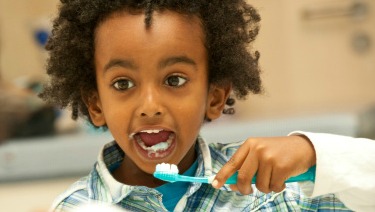
    Tooth brushing should be done for children under the age of 7 years by a parent twice daily, using soft toothbrush appropriate for the child’s age and fluoride containing tooth paste. In children under the age of 3 years, a ‘smear amount of fluoride containing toothpaste should be used while children 3-6 years should have a pea- size amount of tooth paste.

    Google Image: Toothpaste sizes for different ages
    Google Image: Toothpaste sizes for different ages

    Children 7 years and above should brush their teeth with the supervision of their parents/caregiver.

    This is the picture of a 4 year old child boy who presented in our clinic with Early childhood caries, his mother fed him with feeding bottle containing sugar drinks and he also slept with the bottle in the mouth.

    4 years old boy with decayed teeth.

    If the child has been brought earlier the child’s teeth would have been saved.
    How can we identify early childhood caries?
    Many times I have heard parents say they didn’t know when it started, it just appeared immediately the teeth started erupting. No it doesn’t just appear. It’s usually a process that if not attended to can progress fast destroying the teeth.
    It starts as a chalky white appearance on the teeth (usually starts with baby front teeth) that is the early stage then it progresses to brown spots on the teeth and then appearance of hole and destruction of the entire teeth leaving only the roots of the teeth in place. The description is shown in the image below.

    Early childhood carries detection
    Early childhood carries detection

Why do we need to protect baby teeth?

  • After all said and done, since they will eventually fall out and be replaced by permanent teeth?
    Here are some of the reasons why we need to protect our children’s teeth.
  • If a child has tooth decay that is left untreated, it can affect the growth, speech, appearance and self esteem of the child.
  • Untreated tooth decay can lead to pain and discomfort which can also lead to infection.
  • Untreated tooth decay can alter a child’s eating due to pain and this can prevent a child from getting the necessary nutrient required for growth.
  • A child’s sleeping habit can also be altered due to severe pain from affected tooth/teeth, risk of hospital admission and subsequently there will be loss of school days and inability of the child to learn.
  • Early childhood caries has been associated with reduced growth and reduced weight gain due to insufficient food intake that can meet the growth need of the child.
  • Untreated tooth decay can also cause early loss of a child’s tooth/teeth which can lead to speech problem because one of the functions of the human teeth is speech, when a child’s teeth are lost early it can affect speech and pronunciation of words.
  • Untreated tooth decay can affect a child’s self esteem, sometimes a child may not want to smile or talk publicly because of the way his/her teeth appears this can affects a child’s confidence if not look, if not looked into can continue till adulthood.

As simple as tooth decay may look it can lead to brain abscess (infection) and death. We do not pray for this. The good news is that early childhood caries( tooth decay) is PREVENTABLE!!!
PREVENTION IS CHEAPER THAN CURE!!

How can we prevent Tooth decay in children

  1. Reduce the transfer of bacteria that cause tooth decay from your mouth to your child. This can be done by minimizing saliva-sharing activities.
    • Avoid the sharing of utensils such as spoons forks with your baby.
    • Do not chew your food and put it in the baby’s mouth.
    • Discourage a child from putting his/her hand in the mother/caregiver’s mouth.
    • Do not lick a pacifier before giving it to a child
    • Do not share toothbrushes.
    • The goal is to prevent or delay children as long as possible from acquiring the bacteria that cause tooth decay.
  2.  Start cleaning your baby’s mouth not later than when the first tooth erupts
    • Tooth brushing should be done for children under the age of 7 years by a parent twice daily, using soft toothbrush appropriate for the child’s age and fluoride containing tooth paste.
    • In children under the age of 3years, a ‘smear amount of fluoride containing toothpaste should be used while children 3-6 years should have a pea- size amount of tooth paste.
    • Children 7 years and above should brush their teeth with the supervision of their parents/caregiver.
  3. Bring your child to see the dentist as soon as the child brings out his/her first tooth. A child’s first visit to the dentist should be on or before the child’s first birthday. This will enable us to monitor the child for any sign of tooth decay and other dental problems that may be starting.
  4. Avoid giving your child liquids, solid foods containing sugar frequently. Avoid sweets, chewing gum, fizzy drinks, biscuits, chocolates. If at all you must give it should be occasionally!
  5. Avoid putting sugar containing drinks like tea, juices, chocolate drinks in baby bottle or training cup.
  6. Do not put your baby to sleep with bottle filled with milk or liquid containing sugars.
  7. ‘On-demand breast-feeding should be avoided after the first tooth has erupted and other dietary carbohydrates have been introduced.
  8. Encourage your baby to drink from a normal cup not trainer cup as he/she are approaching their first birthday.
  9. Infants should be weaned from the bottle between 12 to 18 months of age.
  10. Regular visits to the dentist is important.
    If your child already has tooth decay no need to worry. It can be treated depending on how severe it is. The teeth can be restored(coated) with white dental material or it can be crowned(capped) to improve the child’s appearance and and improve the ability to chew and eat.
    In conclusion, tooth decay in children is preventable, if a child has tooth decay and is not treated it can lead to other complications.
    Following the pieces of advice in this blog post will lead to prevention of tooth decay in children.

Oral Hygiene in Children – Dr Tosin Bolarinwa

Good oral hygiene is the single most important factor in keeping your teeth and gums healthy and good habits formed in childhood will last a lifetime. Children should be encouraged to take care of their teeth from an early age so that a good oral hygiene routine is instilled in them.

In this article based on a group discussion facilitated by Dr Tosin Bolarinwa, dentist on our Ask The Paediatricians Facebook group recently, you will know all you need to know about your children’s teeth and how to take care good care of them.

The mouth is the gateway to the body and just like any other part of your body, if something goes wrong in the mouth, your whole body will know about it, just ask anyone who’s ever had toothache. Poor oral health has been linked to many other diseases.


What is Plaque?

Plaque is a soft sticky film made up of INVISIBLE masses of BACTERIA that live in ALL mouths and sticks to all tooth surfaces. Proper brushing of our teeth is what removes this plaque from our teeth.

Plaque at the early stages is easy to remove, if it’s not removed with proper brushing and flossing it can combine with minerals in saliva and harden to form TARTAR (a.k.a CALCULUS) which is difficult to remove and can only be removed by a dental professional. This tartar picks up stains from the food we eat and is responsible for some discoloured teeth, this is another reason why we need to get rid of this harmful substance daily!

Why do we need to remove plaque form our teeth?

A build up of plaque can cause TOOTH DECAY (caries or cavities) and GUM DISEASE(gingivitis and periodontitis). Plaque cannot be prevented from forming, but careful toothbrushing everyday will help remove it.

Tooth decay (Dental caries) – The BACTERIA in PLAQUE interacts with SUGARS and STARCHES in our diet and produces an ACID. This acid Demineralises (eats away or dissolves) the teeth causing tooth decay

Gum disease (Gingivitis & Periodontitis)

The BACTERIA found in the PLAQUE produces TOXINS (poisons) that irritates the GUMS (gingiva) resulting in INFLAMMATION of the gums which is seen as a red, puffy appearance of the gums and bleeding when brushing or flossing. Your body essentially senses something is wrong /foreign around your gums and your body sets out to get rid of the problem through the process of inflammation and this destroys the gum tissue in the process.

Healthy gums should be firm, pink or dark brown (in dark skinned individuals) and should hug the teeth tightly. Gum disease is PREVENTABLE and easily TREATABLE if caught in the early stages.

Signs of Gum Disease

  • Bleeding- Bleeding gums during tooth brushing, flossing or any other time
  • Puffiness- Swollen and bright red gums
  • Bad breath- Constant bad breath that does not clear up with brushing and flossing
  • Recession- Gums that have receded away from the teeth, sometimes exposing the root

Please note- If you notice any bleeding while brushing yours or your child’s teeth. It is not normal, please do not ignore it. It’s a sign of gum disease.

How do I clean / care for my child’s teeth

In this section we will go through how to care for your child’s teeth, toothpaste choices, quantity and how to prevent tooth decay and gum disease.

When should I start brushing my baby’s teeth?

Start brushing your baby’s teeth as soon as they show up in the mouth to remove plaque. Before the first tooth emerges, you can clean your baby’s mouth daily with a soft washcloth or clean piece of gauze and water.

Whitish coating on babies tongue, gums, inside the cheeks and all over the mouth can sometimes be ‘Oral thrush’ and this can be mistaken for milk patches, the only way to be sure is by regular cleaning. Milk patches will rub off easily, oral thrush will not. Oral thrush in babies will need treatment with antifungals.

When you start early you baby will be used to you cleaning their mouths so introducing a toothbrush won’t be a problem.

Please note- Glycerine is not required to clean baby’s mouth at this age.

Which toothpaste should I use for my child?

  • Children ages three years and under should use toothpaste with a fluoride level of at least 1,000ppm (parts per million).
  • After three years of age, children should use toothpaste with a fluoride level of 1,350-1,500ppm. Most adult toothpaste fall within this range.The level of fluoride in every toothpaste can be found on the toothpaste pack.

Why Fluoride toothpaste ?

  • Fluoride helps prevent decay by keeping tooth enamel strong and more resistant to acids formed by bacteria(prevents demineralization).
  • It also aids in repairing and reversing the early stages of decay(promotes remineralization)
    This is why many professional health bodies recommend.
  • Fluoride free toothpastes and herbal toothpastes do not contain this important ingredient.

Why Fluoride toothpaste ?

  • Fluoride helps prevent decay by keeping tooth enamel strong and more resistant to acids formed by bacteria(prevents demineralization).
  • It also aids in repairing and reversing the early stages of decay(promotes remineralization)
  • This is why many professional health bodies recommend its use. Fluoride free toothpastes and herbal toothpastes do not contain this important ingredient.
  • Please note- Things like Bicarbonate of soda, salt, lime juice, charcoal and the likes are not suitable alternatives to fluoride toothpastes and should certainly not be used in children’s mouth. They are all abrasive can cause irreversible damage to children’s teeth.

How much toothpaste should I use?

Ingesting too much fluoride can cause fluorosis (a defect of enamel during tooth development). Because children may swallow some of the toothpaste they brush with, it is important that the quantity of toothpaste used is monitored.

  • Below the age of three years, children should use just a smear of toothpaste(about the size of a grain of rice).
  • Children aged between three and six years should use a pea-sized blob of toothpaste.

How often should we brush and how long?

Brush your child’s teeth for about TWO minutes TWICE a day: once just before bedtime and at least one other time during the day. Preferably after breakfast! This I know sounds strange because we’ve been raised all our lives to brush before eating in the mornings but if you brush your teeth before going to bed at night, then after breakfast is ideal for your next brushing session.

The night time brushing is most important because it helps get rid of all food consumed during the day and also because the cleansing action of saliva is reduced when we sleep so any bacteria left on teeth overnight have plenty of hours to damage the teeth and gums during sleep. Remember nothing to eat or drink except water after brushing the teeth at night.

The easiest way to brush a baby’s teeth is to sit them on your knee with their head resting against your chest.
With an older child, sit or stand behind them and tilt their head upwards cradling their chin in your hand so you can reach their top and bottom teeth more easily. If possible do the brushing in front of a mirror so the child can see what you are doing.

For infants, toddlers and young children brush their teeth in small circles covering all the surfaces and let your child spit the toothpaste out afterwards. Rinsing with water has been found to reduce the benefit of fluoride so no need to rinse.

As children grow older it is likely they want to participate in toothbrushing time but they can’t do it effectively, you can allow them to take a turn before or after you do their brushing.
Supervise tooth brushing until your child is seven or eight years old, either by brushing their teeth yourself or, if they brush their own teeth, by watching how they do it. From the age of seven or eight they should be able to brush their own teeth, but it’s still a good idea to watch them from time to time to make sure they brush properly.

Once children go into mixed dentition (a period when they have a mixture of both adult teeth and baby teeth in their mouths) the spaces in between teeth become smaller and toothbrushing alone cannot effectively remove the plaque in between teeth so teeth should be flossed once a day as soon as two teeth are touching. If your child has two teeth touching each other then it’s a good idea to floss in between the two teeth.

Dental floss(a cord used to clean in between teeth) is designed to remove particles from between the teeth without causing damage to the gum.

Please note: Cocktail sticks a.k.a toothpicks are not ideal for picking in between teeth as it can cause trauma to the gums.

Brushing Technique

  • Place the toothbrush at a 45-degree angle against the gums.
  • Brush each tooth in a gentle, circular motion. Harshly scrubbing back and forth can damage the gums. The circular motion does the best job of both removing the plaque along the gum line and massaging the gums.
  • Brush the outer tooth surfaces, the inner tooth surfaces, and the chewing surfaces of the teeth. Brush systematically by dividing the mouth into 4 quadrants (using the tip of the nose as an imaginary dividing line) upper left, upper right, lower left and lower right quadrants. Brush one quadrant at a time for about 30 seconds covering all surfaces before moving to the next quadrant.
  • Use the tip of the brush to clean the inside surfaces of the front teeth, using a gentle up-and-down stroke. For the chewing surface use forward and backward movements.
  • Brush the tongue to remove bacteria and freshen breath.

Which toothbrush should my child use?

Choose an age appropriate toothbrush for your child, look at the packaging to see what age range the brush is designed for. Children’s toothbrush should fit comfortably in their mouths and be easy to hold and manipulate. Choose a toothbrush with soft bristles this types of brush heads clean kids’ teeth well without being rough on their gums.
After every use, clean the toothbrush throughly and keep it upright to air dry it. Leaving the toothbrush constantly wet will promote growth of germs. If you have a ventilated toothbrush cover then use it to cover the toothbrush when not in use.

How often should I change my child’s toothbrush?

With repeated use toothbrush bristles wear away and are no longer effective in removing plaque. Toothbrushes are ready to be changed when the bristles fray and no longer stand up straight or after 3 months, whichever comes first. It is also advisable to change your child’s toothbrush after a period of illness to avoid reinfection. Children tend to chew and bite on their toothbrushes and the bristles will degrade much faster than adult toothbrushes. Toothbrushes that are worn will not clean effectively. Change them.

Tooth-brushing resistance

It’s not uncommon for tooth-brushing to be a daily battle for some toddlers. I have talked extensively about this in a post on this forum last year. Please refer to ATP archives for more information on how to manage a child who just doesn’t like tooth-brushing or see the link below.

Protecting children’s oral health

Bacteria that causes tooth decay can be passed from parent and caregivers to child.
A few of the most common ways this happens is by sharing toothbrushes, transferring saliva from eating utensils, by parents using their mouth to clean a pacifier, pre-chewing food or testing the temperature of the liquid in a feeding bottle before giving it to a child. To most parents these things are normal and almost unavoidable right? So what’s the way forward?

To prevent parents and caregivers passing bacteria onto children, the first step is to make sure they themselves have good oral health. By following a good oral health routine of their own, parents and caregivers decrease the chances of passing on any bacteria to their children.

Please note- Toothbrushes are personal items and should not be shared with ANYONE.

Why bother looking after baby teeth since they will eventually fall out?

Baby teeth usually starts erupting by 6 months and by 2 1/2-3 years all 20 baby teeth would have appeared in the mouth. Teeth start to fall out around age 6 and the last of the baby teeth usually fall out around age 12 which means some baby teeth will be in the mouth for several years(10 years for some teeth!) so they need to be kept healthy.

The baby teeth are essential for chewing, learning to talk, correct pronunciation, and proper alignment of adult teeth.

To keep your child’s mouth healthy, avoid filling your infant’s baby bottle with liquids such as sugar water, juice or soft drinks and don’t put him or her to bed with a bottle. If your child uses a pacifier, never dip it in honey or sugar. Try to stop bottle feeding by the age of 1. There will be more information on this in the discussion on dental caries.

Regular Dental check up

Don’t wait till there’s a problem before taking your child to see a dentist.

The times we live in are changing. Many of us grew up in Nigeria and never needed to go to the dentist. Why? Consumption of sweets, chocolates, cakes, juices, fizzy drinks and other sugary snacks were limited to special occasions, they were not everyday treats like they are now. Children these days are exposed to high caries risk diet and so they will need to be seen more regularly for dental check ups.

About 17 years ago handheld mobile phones were relatively uncommon in Nigeria but over the years as their popularity has increased so has the need for mobile shops, accessories shops as well as technicians who will repair them should things go wrong. In the same vein as fast food restaurants, eateries, cakes and desert shops have become very popular with the modern family and children’s parties have become sugar-fests for the younger generation, we need to imbibe the culture of regular visits to the dentist to check the health of our teeth and that of our children.

The ideal time for the first dental visit of a child as recommended by many professional dental organizations across the world is by the age of one year. My preference is as soon as their first milk teeth appear.

The reasons are: your child’s dentist can give you the correct instructions on how to care for your child’s developing dentition and they will also be able to give preventative advice on common oral health problems.

Please note- The early teenage years is an age of vulnerability to decay and gum disease due to a lot of factors. Gingivitis intensifies during puberty which is a period of hormonal changes so please be involved as much as is possible in the oral hygiene of your teenagers as well.

MY BABY HAS “OKA”!

If you are not from Nigeria, you may be lost from the title alone. The typical Naija Mum knows what I am talking about, especially if you are from the South-Western part of the country, specifically the Yoruba tribe. The other tribes have their own names for the same condition. A mum told me it is called “ndawa isi” in Ibo. Someone should tell me the Hausa name.


What is “oka”?

A lot of Nigerian Mums ask me countless number of times if their babies have “Oka”. In fact, most do not ask “if” as they have been handed the standard diagnosis of “Oka” by the Grannies stat. Their own question is whether they should give “agbo oka” that is native concotion or herbal remedies for the “Oka”. Another category of mums have gone beyond that and have started the treatment for “Oka”. How do I know? Once you see a new baby with clean shaven head and sticky blackish substance applied to the scalp toward the front, you are seeing a child undergoing treatment for “Oka”.

So what is this “Oka”?

The Grannies and some mums believe that there is a “hole” or “space” which is “breathing” or pulsating in the head of the new baby which is abnormal. That this soft space is not right and should not be there. Any baby that has this “abnormal space or hole” is diagnosed with “Oka”.

For fat, hairy babies, the “hole” is not so apparent and often ignored. However, in smaller babies who are also not gaining weight or perhaps loosing weight, the space is very prominent and can even be sunken. Such babies are easily labelled as having “Oka” and commenced on all forms of treatment ranging from application of substances on the scalp to drinking herbal remedies. There are lots of myths and beliefs surrounding this “Oka”.

So why am I talking about “Oka”?

Some years ago, during my residency training to become a Paediatrician, I was working at the Children Emergency Room (CHER) at the Lagos University Teaching Hospital when two women rushed in with a baby crying. That is not unusual in CHER. What was terrifying that day was when I saw the baby rushed in. He was about 2 – 3 months old. For the first time in my life, I was seeing the brain live and direct in a living person who was not being operated. This was not a movie scene! The brain of this baby was completely visible to everyone. What happened?

In the usual fashion, the grandma who came for “omugwo” had made a diagnosis of “Oka” and has prescribed the traditional treatment which was coating the surface with a black material. Unfortunately, in this scenario, whatever substance was applied was so caustic, it eroded (burnt) away the membrane of the anterior fontanelle and you can see the baby’s brain live and direct!!! Of course, this was disastrous….for baby, mother and grandma and even us the doctors.

That is why I talk and educate mums about this traditional myths and beliefs that are dangerous to children’s health. Of course, granny did not mean to harm her precious grandson but she did anyway.  That baby had to undergo brain surgery. Of course, he had serious infection of the brain even before and after surgery. Though he did not die, but there are long-term complications he will face all because of someone’s ignorance. No wonder, ignorance is more expensive than education.

Facts to know about “OKA”

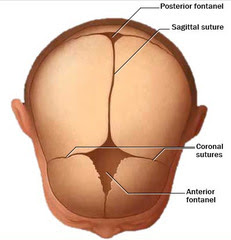
  1. The “soft hole or space” often erroneously believed to be an abnormality is A NORMAL PART of the baby’s head. It is called ANTERIOR FONTANELLE (AF).
    Every baby has it. It is there to allow along with the small spaces (sutures) between the different bones of the skull to accommodate the baby’s brain growth. So it is not “OKA” or any other thing….It is a normal part of the baby’s head.
  2. The anterior fontanelle (AF) is covered by a membrane, and this membrane is what actually separates the baby’s brain from the environment. It is that important! So any application of substances that can damage this membrane will lead to exposure of the brain to the environment with serious consequences like in the story above.
  3. The fact that in some babies, very hairy or chubby especially, that you can not see it pulsating or “breathing” in local naija parlance does not mean it is not there. Some mums have actually said their babies do not anterior fontanelle! That is not true….every baby is born with one!
  4. The size and shape of the AF varies from one baby to another normally. In some conditions, it can be too big. Also the anterior fontannelle can be elevated “bulging” in some conditions especially if the baby has infections in the brain. It can be depressed “sunken” in other conditions like in babies that are very dehydrated or malnourished.
    Please note that in these conditions, it is not the AF causing the disease symptoms (for example diarrhoea and dehydration with sunken AF). Rather, the AF is just reflecting the fact that something is wrong in the body systems.
    It is important to say this because this is one of the reasons some mums believe in “OKA”. Such babies are sick and may either have prominent or sunken AF in addition to other symptoms. The “OKA doctors” will now say it is the “oka” causing the symptoms.
    The danger of this belief is all treatments will be directed to the AF and the underlying disease causing the change in AF will be ignored. Also some of the native medications often use d have dangerous side effects and consequences especially on the immature liver and kidneys of the babies causing further damage….”fry pan to fire” scenario!!!
  5. The AF closes on its own by age of 18 – 24 months. This is because more than 90% of brain growth and development has occurred by the age of 2 years. You did not need to do anything about it. It happens on its own. Just to note that some diseases can cause delay in closure of the AF. See your paediatrician if you can still feel the AF in your baby after age 2 years.
  6. You did not need to apply oil to the AF hourly or daily….highly unnecessary and the dripping oil will cause rashes on the baby’s face. The AF is not “drying up” like many naija mums believe. You also do not need to put thread from cloth. You also do not need to mop AF with hot water or apply any substances local or herbal on it. JUST LEAVE THE AF ALONE!!7. Finally if your baby is sick with or without observed changes in the AF, please go to the Hospital immediately. Don’t assume and don’t accept the “OKA” diagnosis. Please see your doctor for proper  diagnosis and treatment. A stitch in time saves nine!

Thank you for reading. I will like to read your thoughts on this “OKA”. Please comment or email me at as******************@***il.com. If you also have questions or clarifications on this issue or any child health issues, feel free to email me. I love reading your questions and comments.
Dr Gbemisola Boyede