Tetanus in Children

I’m sure you have heard about tetanus especially the vaccine against tetanus; perhaps you have taken one. In this article, you would read about the cause of tetanus, how common it is, the symptoms, the treatment of tetanus and most importantly how to prevent tetanus in children.

What is Tetanus?

Tetanus is a severe neurological disease due to bacterial infection from the bacterium known as Clostridium tetani. This Clostridium tetani often produce spores which easily contaminates dirty wounds and can lead to the disease – tetanus within 14 days.

Tetanus used to be one of those conditions that used to be so feared and common, but thankfully, the incidence of severe tetanus is beginning to reduce, especially in newborns. Thanks to the availability of the tetanus toxoid vaccine which if given to mothers can prevent their newborns from having the often fatal neonatal tetanus.

How common is Tetanus?

Tetanus is still common in low-income countries or districts, where immunization coverage is low and unclean birth practices are common. WHO estimates that in 2018, 25 000 newborns died from neonatal tetanus, 88% reduction from the situation in 2000.

How does one get Tetanus?

The tetanus bacteria produces some toxins which can damage the nerves in the body. This often manifests as involuntary spasms. The involuntary spasms can affect any part of the body. Prolonged spasms can cause further damage to the muscles which can lead to kidney failure, and in severe cases death.

Who can have Tetanus?

People of all ages can get tetanus but the disease is particularly common and serious in newborn babies and their mothers when the mother is unprotected from tetanus by the vaccine, tetanus toxoid. Tetanus occurring during pregnancy or within 6 weeks of the end of pregnancy is called maternal tetanus, while tetanus occurring within the first 28 days of life is called neonatal tetanus. 

Symptoms of Tetanus

Tetanus can be localized meaning it is limited to only one part of the body or it can be generalized affecting multiple organs in the body at the same time. The localised tetanus is usually mild form of tetanus while the generalized one tends to be severe and can be fatal.

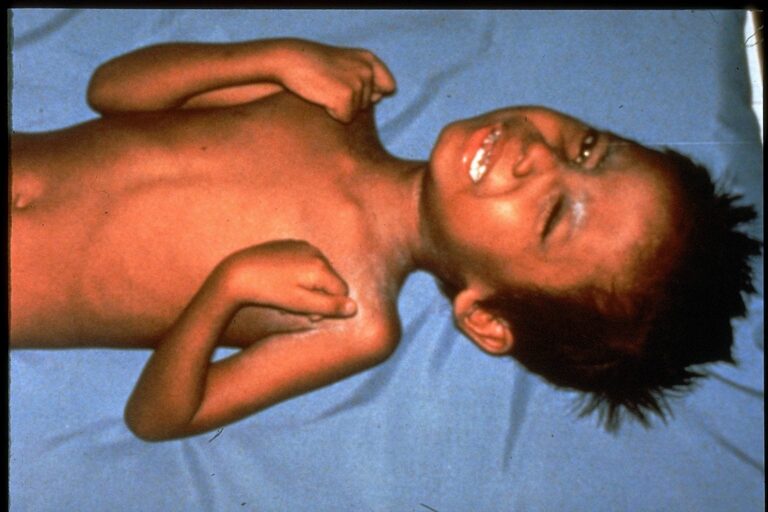
Symptoms of Tetanus also depend on age group. For adults and older children, it may first present as locked jaw where they affected person can not open their mouth. Later, they begin to have muscle spasms. Spasms is the hall-mark symptom of Tetanus in most age groups. It looks like convulsion but can be described as sudden electric shocks which happen repeatedly. The spasms can affect all the muscles in the body.

Usually the child is conscious during these episodes of muscle spasms which are usually very painful. This muscle spasms can occur in any part of the body including the arms, legs, abdomen. The spasms tends to be triggered by things like noise, sudden movements and light.

Other symptoms of tetanus include difficulty in swallowing, headaches, fever, excessive sweating and convulsion (different from the spasm). The toxins can also affect others nerves in the nervous system known as the autonomic nervous system that regulate heart rate, blood pressure and breathing. This can lead to some patients with Tetanus ending up in Intensive care unit if very severe.

Symptoms of tetanus in babies usually start with refusal to suck. The babies with neonatal tetanus are usually irritable, crying before they start having the spasms.

Diagnosis of Tetanus

Most times, once the spasms occur it is very easy to make a diagnosis of tetanus. Tetanus is one of the easiest clinical diagnosis to make because the spasms are so peculiar to tetanus. In addition one can often easily spot the entry wound for the tetanus. In children, the wound is usually seen. Other sources of tetanus infections especially babies include the umbilical cord if covered with cow dung or cut with unsterilised and contaminated instruments. Chronic ear infection with pus can also be a source of the infection.

How is Tetanus treated?

Treatment of Tetanus involves

  • neutralizing the toxin
  • getting rid of the bacteria
  • symptomatic relief of the spasms
  • treating any other complications

Doctors neutralize the tetanus toxins using human tetanus immunoglobulin. Previously, we were using the horse ones antitetanus serum but now Human ones are being used which are safer. The immunoglobulin neutralize the toxins before they bind to the nerves and cause spasms.

Additionally, we get rid of the source of the tetanus bacteria spores by treating the wound, infected umbilical cord and ear infection. This may involve cleaning them out especially removal of dead tissues and by giving antibiotics treatment that the tetanus bacterium is sensitive to.

The spasms are managed by using medications that can relax the muscles.The most painful part of the tetanus is the muscle spasms which are painful, so muscle relaxant e.g. diazepam (valium) are given every four hours, frequently, in drip and bolus, to reduce the spasm and relax the muscles. Other symptomatic treatment are also necessary and in some cases may require ICU care.

Prevention of Tetanus

The most important and the best part is Tetanus is preventable. No child need to experience tetanus is one of the vaccine preventable disease. We have an effective vaccine against tetanus – the tetanus toxoid vaccine (TT)

In newborns, mothers have important role in preventing tetanus by ensuring that they are fully immunized against tetanus during pregnancy. There are five doses of the TT vaccine that all women of child-bearing age should take especially if living in areas where there clean deliveries supervised in hospital are not universal. See the timetable below

The main reason for immunizing the mothers is primarily because of the babies, even though the mother is also immunized. If a mother is immunized, her baby will be immunized.

In addition to immunization, mothers should ensure they deliver their baby in a standard hospital where deliveries take place in clean environment and sterilized instruments are used to cut the cord. Traditional birth centers often do not ensure such details.

Cord care is also important in preventing tetanus in the newborns. The navel is usually the entry point for tetanus in newborns. Cord care should be done by applying chlorhexidine gel once a day or using 70% methylated spirit every four hours to clean the cord. the navel should be exposed to air and not covered with bandages or nappies. Things like dusting powder, toothpaste, cow dung, mentholated balm and heat (wet or dry) should not be applied to the navel. Advantage of chlorhexidine gel is that mothers can just apply once a day for seven days, which is less stressful yet sufficient to protect the child from bacteria infection of the navel including that of tetanus bacteria. Where no gel is available, methylated spirit is fine but requires frequent cleaning every 4 hour. The cord care should continue the navel is fully healed. .

For older children, the main prevention from tetanus is routine immunizations. Tetanus toxoid vaccine is part of the routine immunizations given as part of the pentavalent vaccine (five in one vaccine) given at 6, 10, and 14 weeks. These three doses protect the children against tetanus until age 18 months. Then booster doses should be given at 18 months, 5, and 10 years because the initial protection tend to wane with time. Each time a child has a major injury or wound including burns; it is also prudent to give a booster dose of tetanus toxoid even though the child is fully immunized.

It is also important that the tetanus toxoid vaccine taken is well-kept to avoid break of the cold chain. Do not take the vaccine in just any clinic or hospital, as some facilities do not preserve their vaccines well due to lack of facilities and equipment to keep the tetanus vaccines in a cold environment, Hence government facilities are the best to go to for immunizations including that of tetanus toxoid as they always ensure the cold chain is not broken.

I hope you have learnt a lot about Tetanus. Feel free to ask your questions in the comments section or on our Facebook group. More importantly, ensure you and your children are fully immunized and protected against Tetanus.

Help Paed! I have a Child with Special Needs (1)

As a Paediatrician with  subspecialty training in Neuro-developmental Paediatrics, I basically take care of all children health issues especially those with physical and mental disabilities. This group of children are often referred to as Children with special needs.
This is a topic I am particularly passionate about especially in the part of the world where I practice with so much ignorance and superstitious beliefs about this wonderful group of children. This post is to provide you with the basic information you should know either as a parent or caregiver with special needs children
Even if you don’t have a child with special needs, you need this information as well to know how to relate better with children and families with special needs.


Who is a  child with Special Needs?

First every single child is special!
But what do we mean when we say “children with special needs”?
Merriam Webster dictionary defined “special needs” as mental, emotional, or physical problems in a child that require a special setting for education.

⦁ This means any child who might need extra help because of a medical, emotional, or learning problem.
⦁ these children have special needs because they might need medicine, therapy, or extra help in school — things that an average child won’t typically need or only need once awhile.
⦁ Basically, these are children with physical and developmental disabilities

Common medical conditions that predispose children to have special needs:-

  • Cerebral palsy
  • Down Syndrome
  • Autism spectrum disorder
  • Intellectual disability
  • Congenital syndromes
  • Hearing impairment “Deaf”
  • Visual impairment “Blind”
  • Learning Disability – Dyslexia, Dysgraphia,
  • Spina Bifida
  • Hydrocephalus
  • Attention Deficit Hyperactivity Disorder
  • Behaviour disorders – conduct disorders, oppositional defiant disorders.

These disabilities can be mild, moderate or severe. Children with disabilities do not constitute a uniform group, We have are children who are completely independent and at the other end of the spectrum are those who are completely dependent on others for every activity of daily living.

Why does my baby have special needs?

  • Disabilities can begin anytime during the developmental period and usually last throughout a person’s lifetime.
  • Most disabilities begin before a baby is born, although some happen after birth.
  • The causes of disabilities in children are often due to multiple factors some of which the affected families have no control over.
  • Sometimes we simply do not know why the condition happened!

Common Causes

The Causes of disabilities BEFORE birth include:

  • Genetic:– Children with Down Syndrome have an extra chromosome 21. There are many other congenital disabilities that have to do with problems at the level of the Chromosomes or genes, some of these may be inherited conditions; others are not.
  • Infections the mother might have during pregnancy affecting the baby in the womb – popularly called the TORCHES can lead to birth of babies who may later have disabilities such as Cerebral palsy, deafness, blindness.
  • Malformation of the brain, spinal cord and other vital organs causing hydrocephalus, spina bifida.
  • Parental health and behaviors (such as smoking and drinking) during pregnancy can cause Fetal alcohol syndrome.

Causes AFTER birth include;

  • Prematurity – babies born before 37 completed weeks of pregnancies
  • Complications during birth – failure to cry at birth (birth asphyxia), birth injuries (Erb’s palsy).
  • Severe Jaundice
  • Severe infections in the early newborn and infancy period especially involving the brain (meningitis)
  • Exposure of the mother or child to high levels of environmental toxins, such as lead.

Disabilities and Prevention

Disabilities and Prevention

Can it happen again? How do I prevent my child from having this challenge again?
Some forms of disabilities can be prevented by simple measures and these include;

• Folic acid intake by all women of the child bearing age – this prevents the spina bifida, hydrocephalus
• Avoidance of smoking and alcohol consumption by pregnant women
• Early registration and proper antenatal care can prevent early deliveries of preterm babies
• Supervised deliveries by skilled medical professionals and well-equipped centres for emergency obstetric care to prevent birth complications
• Early detection and treatment of some medical diseases in neonatal and infancy period especially jaundice and severe neonatal infections
• Screening for the genetic disorders
• Early presentation to the Hospital and diagnosis and treatment of the disabilities to avoid further worsening of the disability and development of secondary complications


Disabilities: – Myths and Misconceptions

There are so many myths and misconceptions rampant in the African society about children with disabilities. These misconceptions often lead to further societal stigmatization of people with disabilities.
They are also contributory to children with disabilities not achieving their maximum potential.
There is no scientific basis for these myths and misconceptions and they are often rooted in ignorance and superstitious beliefs.
Common myths and misconceptions on disabilities include;

  • Spiritual cause – Most disabilities are not due to spiritual causes as we have stated the causes above. They are not due to demonic afflictions or witchcraft.
  • Disabilities are contagious – Associating or interacting with children with disabilities does not mean the person will also develop disabilities. There is a belief that a pregnant woman who stays around such children will have children with disabilities; that is not true.
  • Society rejects/outcasts – people with disabilities are believed to be unnecessary burden to the society who can never be productive or achieve anything in life. This is responsible for the high rate of physical abandonment and/or neglect of such children. Such children are even killed at times in extreme cases. This is cruel and criminal. Children with disabilities with the right support can live to achieve their maximum potential.

Famous People with Disabilities

Disability is not a death sentence! Children and adults with special needs and disabilities can live good quality lives that can benefit the society despite the challenges they may face.
A brief Google search will reveal many successful people in the world with disabilities ranging from a former US President to many athletes, authors, evangelists in the recent past and contemporary times as well.

This is not limited to the developed world. In Nigeria, we have our own successful people with disabilities. Cobhmas the prolific music producer is blind. Tobiloba Ajayi is a lawyer and CP advocate with cerebral palsy. Many children with special needs have done Nigeria proud by winning gold at the Special Olympics. With advancement in technology are living full and productive lives.

A very inspirational example is Nicholas James “Nick” Vujicic, an Australian Christian evangelist and motivational speaker born with Phocomelia, a rare disorder characterized by the absence of legs and arms. He has written books, married with two children and often speak to thousands of people to motivate them to fulfill their maximum potential.

This is not limited to the developed world. In Nigeria, we have our own successful people with disabilities. Cobhmas the prolific music producer is blind. Tobiloba Ajayi is a lawyer and CP advocate with cerebral palsy. Many children with special needs have done Nigeria proud by winning gold at the Special Olympics. With advancement in technology are living full and productive lives..

Conclusion:

We should all seek to understand children and individuals with disabilities and support them in achieving their maximum potential.
There is always hope and ability in every disability!

Myths about Child Healthcare in Nigeria / Africa – The Good, Bad and Ugly!!!

Hello Everyone!

So we will be sharing some myths we have heard and superstitious beliefs we are use to pertaining to child healthcare in Nigeria. As we know, in this part of the world, her in Africa,Nigeria to be precise we have some ‘laws’ or should say ‘practices’  unorthodox,funny and sometimes ridiculous with no basis and sometimes very  DANGEROUS!  Others can HARMLESS and some can be  BENEFICIAL

I will be sharing few of these myths, in a view to correct some wrong practice and superstitions! You can send your feedback,questions,thoughts using the comment below or send an email to as*@******************ns.com


Dangerous Myths

  • MYTHS: The believe that the cord on a new born must drop before the naming ceremony and applying toothpaste or  ashes on it to forcefully remove it.
    COMMENT: Like every wound in the body, the cord is also a wound. The way our wounds heals differs based on skin type, some 3 days, others longer like 10 days. Cord falling off shouldn’t be a perquisite for naming ceremony. Toothpaste and ashes are dangerous; they provide means of introducing infection to the newborn.
  • MYTHS: As a pregnant mother, when the other older child tags along with you and always lays close to your tummy. He/She will always be ill.
    COMMENTS: False & Dangerous
  • MYTHS: Putting breast milk in your baby eye when is redish or bringing pus.
    COMMENT: Dangerous! PLEASE DO NOT PUT BREAST MILK IN THE EYES…..SEE A DOCTOR
  • MYTHS: giving a baby concoction agbo at early birth,
    COMMENT: I go against all this but mother in law feel *you too know*. DANGEROUS….DO NOT DO IT!!
  • MYTHS: When my second baby came, I was told to bath the first one with  dirty water used by the new baby to bath the first one, so that he will not disturb me and stop crying.
    COMMENT: FALSE AND DANGEROUS…..DO NOT DO IT
  • MYTHS: The belief that if a crawling baby eats his/her poop unknowingly, the mother is suppose to taste from the poop also else something terrible would happen to the child
    COMMENTS: DANGEROUS….RISK OF INFECTIONS BUT YOU AS A MUM TOO SHOULD NOT ALLOW THE BABY TO ALSO EAT POOP NOW!!!
  • MYTHS: That a pregnant woman should not eat grass cutter, because it causes prolong labor,  and in a situation where a woman is having such a labor and it’s being confirmed that she ate grass cutter, the bones of the animal should be brought to her to the hospital
    COMMENT: You need protein while pregnant and if grass cutter is the only source in your area please go ahead and eat
  • MYTHS: Pressing the breast of new born
    COMMENT: Dangerous.… Please DON’T DO IT
  • MYTHS: That a woman who is pregnant must not eat fried plantain to avoid of oka ori in Yoruba.
    COMMENT:  OK this one is FUNNY! You need iron and other nutrients present in the plantain!
  • MYTHS: Putting spoon in d mouth of a convulsing child or onions and palm kernel oil (ude-aku)
    COMMENT:  Please Biko! I beg of you DON’T!…. Read more on the group discussion on convulsion in children
  • MYTHS: When you give birth to a baby, drop coconut water inside the baby’s mouth so that the child to prevent stomach pain. Is this true?
    COMMENT:  False and dangerous.

A mom should never allow her baby fall from her back. Otherwise, the child will only know bad luck.
So many others that I have forgotten

COMMENT: False, but good myth at least for prevention of head injury not necessarily the bad luck part


We will stop here for now, be sure to check back for more updates!
Don’t join the bandwagon, Information is light, keep your kids safe an healthy!

Help Paed! I have a Child with Special Needs (2)

This is the concluding part of the article on what parents and caregivers need to know about children with special needs. Having to take care of a child with special needs come with a lot of challenges, these are not insurmountable with the right help…

What Kind of Help do I Need?

Two categories of Help are needed :-
• for the children with special needs
• for the parents/caregivers/siblings/families.


Help for the Children

• Diagnosis – what is the condition my baby really have. Never assume; get a professional to evaluate your child and confirm the diagnosis
• Treatment – medications
• Treatment – therapies
• Psychological support
• Education
• Community inclusion/participation
Early diagnosis;

  • Diagnosis – what is the condition my baby really have. Never assume; get a professional to evaluate your child and confirm the diagnosis.
  • Treatment – medications
  • Treatment – therapies
  • Psychological support
  • Community inclusion/participation

Help For the Children;
Children observed to have obvious physical disabilities or delay in achieving their milestones should be taken to the Hospital to see a Paediatrician for proper evaluation and treatment. Early diagnosis and intervention often lead to better outcome for affected children especially for children with mild to moderately severe disabilities.

Treatment and therapies;
There are some disability cases that have definite treatment if picked up early for example a shunt can be inserted for children with hydrocephalus. Others may not have specific and definitive treatment but can be managed through therapies such as physiotherapy, occupational therapy, speech therapy and use of assistant-devices.
Inclusive education;
Children with some special needs can attend the mainstream schools that offer supportive and inclusive education. All children with disabilities should be encouraged to achieve their maximum potential by being offered education. For those who cannot attend school, there are special needs schools that may be more appropriate. You can discuss with your Developmental Paediatrician about the best centres available for placement for your child
Support group;
It is quite tasking and overwhelming to take care of children with special needs children. It is important to get all the support you can from friends and families. This may also include joining support groups available for various disabilities organized by organizations and centres who take care of children with special needs. Sometimes, you just need to know you are not alone and don’t be ashamed to ask for help.

Professionals Involved In The Care Of Special Needs Children

• Developmental Paediatricians
• Physiotherapists
• Speech therapists/Audiologists
• Occupational therapists
• Behaviour therapists
• Special education teachers
• Psychologists
• Specialists – psychiatrists, orthopaedic surgeons, Neurosurgeons, ENT
• Diagnosis rest with the Paediatricians especially the Developmental Paediatricians and/or Paediatric Neurologists.
• Diagnosis can be undertaken to a large extent in the Teaching hospitals.
• Some Private assessments by the therapists and schools
• Confirmation via imaging – CT Scan , MRl available though expensive.
• Genetic testing /metabolic – very limited but can be arranged with partners in neighbouring African countries especially South Africa, UK, USA

FOR THE PARENTS/SIBLINGS
• Spiritual – Pastors, Imams, religious groups
• Family – extended family esp grannies, siblings
• Psychological support – psychologists, organizations
• Financial support
• Information and awareness
• Education – Be the expert in that condition that your child has
• Advocacy


Challenges parents/family face in care of special needs children?
• Burnt out
• Depression
• Stigma
• Loss of income
• Financial challenges
• Marital challenges
• Lack of support by external family and friends
• Lack of facilities and therapists/specialists for the child
Practical steps in managing a child with special needs
• Get a diagnosis and get it early
• Take time to get well informed about the condition – know the life cycle or prognosis so you don’t get too frustrated
• Seek help in the right places at the right time – Don’t wish the condition away.
• Focus on what the child can do and what you can do something about instead of what you can not handle
• There is nothing wrong with spiritual intervention but do not neglect the medical intervention
• Always take decision in the best interest of the child
• Get Support – it is virtually impossible to do it alone….DO NOT BE TOO STRONG!!!
• As you take care of your child, remember the child is dependent on you; so you are very important to the child as well; so take care of yourself!!!
Tips to taking care of yourself
• Know you are not alone
• Psychological support
• Support Group
• Surround yourself with people who are positive
• Turn your lemon to lemonades
• Prayers
• Respite care

Daycare / Creche Centre:- Finding Healthy And Safe Place For Children

Searching for the right day care center for your child can be not so interesting. Getting a daycare centre that will keep your baby healthy is an even tougher one. Unfortunately, with the return to day care inevitably comes the spread of germs that can cause an array of health issues, such as ear infections, colds, coughs, sore throats, runny noses, fever, vomiting and diarrhea. It’s not such an easy task
If the child is currently attending day care, how can one keep them from getting sick? Stopping the spread of germs may seem like a daunting task, but there are several simple ways parents, caregivers and day care staff can take to promote good health which will really pay off!
Education and development are important, but we know that nothing matters more than the safety, security and health of the child. That’s why protection and preparedness are critical considerations.


Top Checks to guarantee a Healthy, Safe and Good Daycare/Creche Centre

Pre-entrance screening by a school or patient paediatrician; this will silent cases like autism which can be picked at early stage.
Wellness: Each child’s health should be assessed by talking with parents and observe each for possible symptoms during each child’s day activities.
Sanitation: Centre should be cleaned each day with safe, non-toxic cleaning products. Cleaning supplies are locked safely out of reach of children. While other child care provider’s clean toys after each day, sanitizing toys throughout the day will better prevent the spread of germs.
Encouraging children to wash their hands throughout the day, singing songs and teaching lessons about health and hygiene.
Diapering: changing of diaper(s) should be done in an area separate from children’s play areas.
Medications: Strict policies for administering medication children should be adhered to, and ensure these medications are protected.
Based on new research about healthy practices for infants and toddlers, a doctor’s note should be given for any medication, prescription or over the counter, given to a child under 2 years to ensure safety.
Safety: A good day care should have a safe, secure perimeters and ensure that children can enjoy outdoor play safely. Use of safety gates, window guards (except fire escapes) and cap electrical outlets, smoke detectors and fire extinguishers are important. Heaters should be well covered to prevent child from touching something hot.
A good day care should have an emergency evacuation plan at a quick reach like, exit doors.
CCTV / Hidden cameras should be an essential component of a good day car; this will allow the day care managers to monitor their staff. Parent having suspicion of wrong doing to their child can request for a playback.
Dedicated, friendly caregivers, nannies who are trained in child development;, early-childhood education or related fields should be employed to take care of the children.
All staff and teachers are to be trained in first aid and Cardiopulmonary resuscitation (CPR).

Source: Hopeumc.com
⦁ Vomiting (after two consecutive bouts)
⦁ Temperature of 38ºC or overEarache
⦁ Complaining of a sore head or stiffness in the neck
⦁ Persistent cough
⦁ ‘Whooping’ cough
⦁ Severe congestion
⦁ Lice
⦁ Contagious illness
⦁ Chickenpox
⦁ Measles
⦁ Mumps
⦁ Meningitis
⦁ Hepatitis
⦁ Impetigo
⦁ Pneumonia (cough, fast breathing and fever)
Day care centers must have a special room that may also serve as school bay; the service of a school nurse may be employed to render first aids before informing parents to come pick up the sick child. Nurse should not give injections except in emergency cases. Isolation of children who may develop communicable diseases like cold, measles, chickenpox.
Concluding Part

Reducing Malaria Infections and Malaria Deaths in Children

CHRONIC ILLNESS  Reducing Malaria infections and Malaria Deaths in Children

It was the World Malaria Day recently on the 25th April 2016. The theme for this year was on ending Malaria for good! What a lofty but achievable dream.

On the Ask The Paediatricians Facebook Group we had a Group Discussion on Malaria anchored by Dr Chudi Godsons.

Here are some important facts about Malaria in Children you need to know.

As parents, you are part of the Squad in the fight to eradicate Malaria completely. Knowledge is very key in this war. This post gives all the information you need to know about Malaria.

World Malaria Day!
World Malaria Day!


What causes Malaria in Children?

Malaria is caused by a parasite called plasmodium, which is transmitted via bites from mosquitoes (female anopheles) which introduce the parasite into the bloodstream.
This is the commonest means of transmitting malaria in children, however there are other ways of transmitting this infection including blood transfusion (infected blood) and trans-placental (through the placenta in pregnant women).
The Malaria parasite lives and feeds on blood (blood borne infection), specifically the red blood cells (RBCs).

malaria in children
malaria in children

Why is Malaria in Children important?

Children are vulnerable to malaria attacks and also are more likely to have severe forms of the infection compared to adults.
Young children, having a poorly developed immune system, can easily develop malaria even with just one bite from mosquitoes.They are also at increased risk of adverse clinical outcomes including anemia and death.
Can malaria be completely eradicated/ prevented among children?
Inasmuch as it might sound oversimplified, the answer is yes. But ALL hands must be on deck to achieve this common goal.Matter of fact in well developed countries, malaria is a rare occurrence. We can replicate same in sub Saharan African including Nigeria.

What are the common symptoms/ presentation of malaria in Children?

  • Fever
  • Sweating
  • Diarrhea and vomiting,
  • Chills and shivering
  • Headaches (children that are old enough to express themselves can give a history of persistent headaches)
  • Fatigue, weakness
  • Poor appetite & cough
  • Anemia – shortage of blood is a symptom that follows malaria
  • Enlargement of the spleen
  • Dehydration

What are the risk factors of malaria in children?

  • Residence in, or travel through, a malarious area (endemic area)
  • No previous exposure to malaria (hence no immunity), for example foreigners.

What are the complications of severe malaria?

Malaria can be fatal, especially the variety that’s common in tropical parts of Africa. In most cases, malaria deaths are related to one or more serious complications listed below:

  • Cerebral malaria – this is one of the dreaded complications of severe malaria. It is a common outcome of poorly treated or untreated malaria in children. Here the parasite-filled blood cells block small blood vessels to your brain (cerebral malaria), leading to swelling of your brain or brain damage may occur. This may cause coma and death.
  • Breathing problems due to accumulated fluid in the lungs of children.
  • Multi Organ failure. Malaria can cause the kidneys or liver to fail and even the spleen to rupture. Any of these conditions can be life-threatening.
  • Anemia – Malaria damages red blood cells, which can result in anemia.
  • Low blood sugar. Severe forms of malaria itself can cause low blood sugar, as can. Very low blood sugar can result in coma or death.

So how is the diagnosis of malaria in children made?

The gold standard is blood tests for malaria parasite. This can show the presence of the parasite and same time, help tailor treatment by determining whether your child has malaria. Some blood tests can take several days to complete, while others can produce results in less than 15 minutes.

What are the treatment options of malaria in children?

Artemisinin-based Combination Therapy (ACT) are the anti-malarials recommended in Nigeria. They are safe and well tolerated by young children. Examples of such ACTs include arthemeter-lumefantrine, artesunate-camoquine and so on.
For severe malaria, the children may require injectable antimalaria initially at the beginning of the treatment.
Please avoid the use of antimalarials like Chloroquine which are no longer in use due to malaria parasite resistance to them. Such practice delays effective treatment and can lead to complicated malaria that can result in deaths.
Also avoid random self-medication and treatment of every fever as Malaria. Malaria must be confirmed by the laboratory tests before treatment.
Always go to the hospital for the tests and prescription of antimalarials by the doctors.
Ensure children take the adequate doses and complete the full treatment even if they are already feeling better.

The preventive steps for Malaria are simple and include:

  • Use of long-lasting insecticidal treated nets. If we prevent the contact between mosquitoes and children, then ultimately, we will banish malaria to pits of hell.
  • Indoor residual spraying – this helps to kill off mosquitoes in households
  • Intermittent preventive treatment of malaria in children especially in areas of high malaria transmission.

In conclusion, Malaria is common here in Nigeria and many parts of Africa; and virtually everyone has had malaria at one point in time or the other. Yet it is important to know that Malaria is a killer especially in young children and pregnant women.
Early confirmation and diagnosis will lead to early treatment with safe ACT antimalarials.

Armed with correct information, together as parents we can end Malaria for good by year 2030!!!

Thank you for reading and I look forward to reading your questions and comments.
You can also join the live discussion on the Ask The Paediatricians Facebook Group.


MY BABY HAS “OKA”!

If you are not from Nigeria, you may be lost from the title alone. The typical Naija Mum knows what I am talking about, especially if you are from the South-Western part of the country, specifically the Yoruba tribe. The other tribes have their own names for the same condition. A mum told me it is called “ndawa isi” in Ibo. Someone should tell me the Hausa name.


What is “oka”?

A lot of Nigerian Mums ask me countless number of times if their babies have “Oka”. In fact, most do not ask “if” as they have been handed the standard diagnosis of “Oka” by the Grannies stat. Their own question is whether they should give “agbo oka” that is native concotion or herbal remedies for the “Oka”. Another category of mums have gone beyond that and have started the treatment for “Oka”. How do I know? Once you see a new baby with clean shaven head and sticky blackish substance applied to the scalp toward the front, you are seeing a child undergoing treatment for “Oka”.

So what is this “Oka”?

The Grannies and some mums believe that there is a “hole” or “space” which is “breathing” or pulsating in the head of the new baby which is abnormal. That this soft space is not right and should not be there. Any baby that has this “abnormal space or hole” is diagnosed with “Oka”.

For fat, hairy babies, the “hole” is not so apparent and often ignored. However, in smaller babies who are also not gaining weight or perhaps loosing weight, the space is very prominent and can even be sunken. Such babies are easily labelled as having “Oka” and commenced on all forms of treatment ranging from application of substances on the scalp to drinking herbal remedies. There are lots of myths and beliefs surrounding this “Oka”.

So why am I talking about “Oka”?

Some years ago, during my residency training to become a Paediatrician, I was working at the Children Emergency Room (CHER) at the Lagos University Teaching Hospital when two women rushed in with a baby crying. That is not unusual in CHER. What was terrifying that day was when I saw the baby rushed in. He was about 2 – 3 months old. For the first time in my life, I was seeing the brain live and direct in a living person who was not being operated. This was not a movie scene! The brain of this baby was completely visible to everyone. What happened?

In the usual fashion, the grandma who came for “omugwo” had made a diagnosis of “Oka” and has prescribed the traditional treatment which was coating the surface with a black material. Unfortunately, in this scenario, whatever substance was applied was so caustic, it eroded (burnt) away the membrane of the anterior fontanelle and you can see the baby’s brain live and direct!!! Of course, this was disastrous….for baby, mother and grandma and even us the doctors.

That is why I talk and educate mums about this traditional myths and beliefs that are dangerous to children’s health. Of course, granny did not mean to harm her precious grandson but she did anyway.  That baby had to undergo brain surgery. Of course, he had serious infection of the brain even before and after surgery. Though he did not die, but there are long-term complications he will face all because of someone’s ignorance. No wonder, ignorance is more expensive than education.

Facts to know about “OKA”

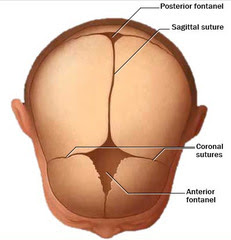
  1. The “soft hole or space” often erroneously believed to be an abnormality is A NORMAL PART of the baby’s head. It is called ANTERIOR FONTANELLE (AF).
    Every baby has it. It is there to allow along with the small spaces (sutures) between the different bones of the skull to accommodate the baby’s brain growth. So it is not “OKA” or any other thing….It is a normal part of the baby’s head.
  2. The anterior fontanelle (AF) is covered by a membrane, and this membrane is what actually separates the baby’s brain from the environment. It is that important! So any application of substances that can damage this membrane will lead to exposure of the brain to the environment with serious consequences like in the story above.
  3. The fact that in some babies, very hairy or chubby especially, that you can not see it pulsating or “breathing” in local naija parlance does not mean it is not there. Some mums have actually said their babies do not anterior fontanelle! That is not true….every baby is born with one!
  4. The size and shape of the AF varies from one baby to another normally. In some conditions, it can be too big. Also the anterior fontannelle can be elevated “bulging” in some conditions especially if the baby has infections in the brain. It can be depressed “sunken” in other conditions like in babies that are very dehydrated or malnourished.
    Please note that in these conditions, it is not the AF causing the disease symptoms (for example diarrhoea and dehydration with sunken AF). Rather, the AF is just reflecting the fact that something is wrong in the body systems.
    It is important to say this because this is one of the reasons some mums believe in “OKA”. Such babies are sick and may either have prominent or sunken AF in addition to other symptoms. The “OKA doctors” will now say it is the “oka” causing the symptoms.
    The danger of this belief is all treatments will be directed to the AF and the underlying disease causing the change in AF will be ignored. Also some of the native medications often use d have dangerous side effects and consequences especially on the immature liver and kidneys of the babies causing further damage….”fry pan to fire” scenario!!!
  5. The AF closes on its own by age of 18 – 24 months. This is because more than 90% of brain growth and development has occurred by the age of 2 years. You did not need to do anything about it. It happens on its own. Just to note that some diseases can cause delay in closure of the AF. See your paediatrician if you can still feel the AF in your baby after age 2 years.
  6. You did not need to apply oil to the AF hourly or daily….highly unnecessary and the dripping oil will cause rashes on the baby’s face. The AF is not “drying up” like many naija mums believe. You also do not need to put thread from cloth. You also do not need to mop AF with hot water or apply any substances local or herbal on it. JUST LEAVE THE AF ALONE!!7. Finally if your baby is sick with or without observed changes in the AF, please go to the Hospital immediately. Don’t assume and don’t accept the “OKA” diagnosis. Please see your doctor for proper  diagnosis and treatment. A stitch in time saves nine!

Thank you for reading. I will like to read your thoughts on this “OKA”. Please comment or email me at as******************@***il.com. If you also have questions or clarifications on this issue or any child health issues, feel free to email me. I love reading your questions and comments.
Dr Gbemisola Boyede