
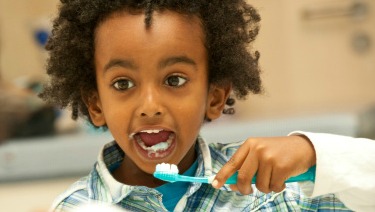
Good oral hygiene is the single most important factor in keeping your teeth and gums healthy and good habits formed in childhood will last a lifetime. Children should be encouraged to take care of their teeth from an early age so that a good oral hygiene routine is instilled in them.
In this article based on a group discussion facilitated by Dr Tosin Bolarinwa, dentist on our Ask The Paediatricians Facebook group recently, you will know all you need to know about your children’s teeth and how to take care good care of them.
The mouth is the gateway to the body and just like any other part of your body, if something goes wrong in the mouth, your whole body will know about it, just ask anyone who’s ever had toothache. Poor oral health has been linked to many other diseases.
What is Plaque?
Plaque is a soft sticky film made up of INVISIBLE masses of BACTERIA that live in ALL mouths and sticks to all tooth surfaces. Proper brushing of our teeth is what removes this plaque from our teeth.
Plaque at the early stages is easy to remove, if it’s not removed with proper brushing and flossing it can combine with minerals in saliva and harden to form TARTAR (a.k.a CALCULUS) which is difficult to remove and can only be removed by a dental professional. This tartar picks up stains from the food we eat and is responsible for some discoloured teeth, this is another reason why we need to get rid of this harmful substance daily!
Why do we need to remove plaque form our teeth?
A build up of plaque can cause TOOTH DECAY (caries or cavities) and GUM DISEASE(gingivitis and periodontitis). Plaque cannot be prevented from forming, but careful toothbrushing everyday will help remove it.
Tooth decay (Dental caries) – The BACTERIA in PLAQUE interacts with SUGARS and STARCHES in our diet and produces an ACID. This acid Demineralises (eats away or dissolves) the teeth causing tooth decay
Gum disease (Gingivitis & Periodontitis)
The BACTERIA found in the PLAQUE produces TOXINS (poisons) that irritates the GUMS (gingiva) resulting in INFLAMMATION of the gums which is seen as a red, puffy appearance of the gums and bleeding when brushing or flossing. Your body essentially senses something is wrong /foreign around your gums and your body sets out to get rid of the problem through the process of inflammation and this destroys the gum tissue in the process.
Healthy gums should be firm, pink or dark brown (in dark skinned individuals) and should hug the teeth tightly. Gum disease is PREVENTABLE and easily TREATABLE if caught in the early stages.
Signs of Gum Disease
- Bleeding- Bleeding gums during tooth brushing, flossing or any other time
- Puffiness- Swollen and bright red gums
- Bad breath- Constant bad breath that does not clear up with brushing and flossing
- Recession- Gums that have receded away from the teeth, sometimes exposing the root
Please note- If you notice any bleeding while brushing yours or your child’s teeth. It is not normal, please do not ignore it. It’s a sign of gum disease.
How do I clean / care for my child’s teeth
In this section we will go through how to care for your child’s teeth, toothpaste choices, quantity and how to prevent tooth decay and gum disease.
When should I start brushing my baby’s teeth?
Start brushing your baby’s teeth as soon as they show up in the mouth to remove plaque. Before the first tooth emerges, you can clean your baby’s mouth daily with a soft washcloth or clean piece of gauze and water.
Whitish coating on babies tongue, gums, inside the cheeks and all over the mouth can sometimes be ‘Oral thrush’ and this can be mistaken for milk patches, the only way to be sure is by regular cleaning. Milk patches will rub off easily, oral thrush will not. Oral thrush in babies will need treatment with antifungals.
When you start early you baby will be used to you cleaning their mouths so introducing a toothbrush won’t be a problem.
Please note- Glycerine is not required to clean baby’s mouth at this age.
Which toothpaste should I use for my child?
- Children ages three years and under should use toothpaste with a fluoride level of at least 1,000ppm (parts per million).
- After three years of age, children should use toothpaste with a fluoride level of 1,350-1,500ppm. Most adult toothpaste fall within this range.The level of fluoride in every toothpaste can be found on the toothpaste pack.
Why Fluoride toothpaste ?
- Fluoride helps prevent decay by keeping tooth enamel strong and more resistant to acids formed by bacteria(prevents demineralization).
- It also aids in repairing and reversing the early stages of decay(promotes remineralization)
This is why many professional health bodies recommend. - Fluoride free toothpastes and herbal toothpastes do not contain this important ingredient.
Why Fluoride toothpaste ?
- Fluoride helps prevent decay by keeping tooth enamel strong and more resistant to acids formed by bacteria(prevents demineralization).
- It also aids in repairing and reversing the early stages of decay(promotes remineralization)
- This is why many professional health bodies recommend its use. Fluoride free toothpastes and herbal toothpastes do not contain this important ingredient.
- Please note- Things like Bicarbonate of soda, salt, lime juice, charcoal and the likes are not suitable alternatives to fluoride toothpastes and should certainly not be used in children’s mouth. They are all abrasive can cause irreversible damage to children’s teeth.
How much toothpaste should I use?
Ingesting too much fluoride can cause fluorosis (a defect of enamel during tooth development). Because children may swallow some of the toothpaste they brush with, it is important that the quantity of toothpaste used is monitored.
- Below the age of three years, children should use just a smear of toothpaste(about the size of a grain of rice).
- Children aged between three and six years should use a pea-sized blob of toothpaste.
How often should we brush and how long?
Brush your child’s teeth for about TWO minutes TWICE a day: once just before bedtime and at least one other time during the day. Preferably after breakfast! This I know sounds strange because we’ve been raised all our lives to brush before eating in the mornings but if you brush your teeth before going to bed at night, then after breakfast is ideal for your next brushing session.
The night time brushing is most important because it helps get rid of all food consumed during the day and also because the cleansing action of saliva is reduced when we sleep so any bacteria left on teeth overnight have plenty of hours to damage the teeth and gums during sleep. Remember nothing to eat or drink except water after brushing the teeth at night.
The easiest way to brush a baby’s teeth is to sit them on your knee with their head resting against your chest.
With an older child, sit or stand behind them and tilt their head upwards cradling their chin in your hand so you can reach their top and bottom teeth more easily. If possible do the brushing in front of a mirror so the child can see what you are doing.
For infants, toddlers and young children brush their teeth in small circles covering all the surfaces and let your child spit the toothpaste out afterwards. Rinsing with water has been found to reduce the benefit of fluoride so no need to rinse.
As children grow older it is likely they want to participate in toothbrushing time but they can’t do it effectively, you can allow them to take a turn before or after you do their brushing.
Supervise tooth brushing until your child is seven or eight years old, either by brushing their teeth yourself or, if they brush their own teeth, by watching how they do it. From the age of seven or eight they should be able to brush their own teeth, but it’s still a good idea to watch them from time to time to make sure they brush properly.
Once children go into mixed dentition (a period when they have a mixture of both adult teeth and baby teeth in their mouths) the spaces in between teeth become smaller and toothbrushing alone cannot effectively remove the plaque in between teeth so teeth should be flossed once a day as soon as two teeth are touching. If your child has two teeth touching each other then it’s a good idea to floss in between the two teeth.
Dental floss(a cord used to clean in between teeth) is designed to remove particles from between the teeth without causing damage to the gum.
Please note: Cocktail sticks a.k.a toothpicks are not ideal for picking in between teeth as it can cause trauma to the gums.
Brushing Technique
- Place the toothbrush at a 45-degree angle against the gums.
- Brush each tooth in a gentle, circular motion. Harshly scrubbing back and forth can damage the gums. The circular motion does the best job of both removing the plaque along the gum line and massaging the gums.
- Brush the outer tooth surfaces, the inner tooth surfaces, and the chewing surfaces of the teeth. Brush systematically by dividing the mouth into 4 quadrants (using the tip of the nose as an imaginary dividing line) upper left, upper right, lower left and lower right quadrants. Brush one quadrant at a time for about 30 seconds covering all surfaces before moving to the next quadrant.
- Use the tip of the brush to clean the inside surfaces of the front teeth, using a gentle up-and-down stroke. For the chewing surface use forward and backward movements.
- Brush the tongue to remove bacteria and freshen breath.
Which toothbrush should my child use?
Choose an age appropriate toothbrush for your child, look at the packaging to see what age range the brush is designed for. Children’s toothbrush should fit comfortably in their mouths and be easy to hold and manipulate. Choose a toothbrush with soft bristles this types of brush heads clean kids’ teeth well without being rough on their gums.
After every use, clean the toothbrush throughly and keep it upright to air dry it. Leaving the toothbrush constantly wet will promote growth of germs. If you have a ventilated toothbrush cover then use it to cover the toothbrush when not in use.
How often should I change my child’s toothbrush?
With repeated use toothbrush bristles wear away and are no longer effective in removing plaque. Toothbrushes are ready to be changed when the bristles fray and no longer stand up straight or after 3 months, whichever comes first. It is also advisable to change your child’s toothbrush after a period of illness to avoid reinfection. Children tend to chew and bite on their toothbrushes and the bristles will degrade much faster than adult toothbrushes. Toothbrushes that are worn will not clean effectively. Change them.
Tooth-brushing resistance
It’s not uncommon for tooth-brushing to be a daily battle for some toddlers. I have talked extensively about this in a post on this forum last year. Please refer to ATP archives for more information on how to manage a child who just doesn’t like tooth-brushing or see the link below.
Protecting children’s oral health
Bacteria that causes tooth decay can be passed from parent and caregivers to child.
A few of the most common ways this happens is by sharing toothbrushes, transferring saliva from eating utensils, by parents using their mouth to clean a pacifier, pre-chewing food or testing the temperature of the liquid in a feeding bottle before giving it to a child. To most parents these things are normal and almost unavoidable right? So what’s the way forward?
To prevent parents and caregivers passing bacteria onto children, the first step is to make sure they themselves have good oral health. By following a good oral health routine of their own, parents and caregivers decrease the chances of passing on any bacteria to their children.
Please note- Toothbrushes are personal items and should not be shared with ANYONE.
Why bother looking after baby teeth since they will eventually fall out?
Baby teeth usually starts erupting by 6 months and by 2 1/2-3 years all 20 baby teeth would have appeared in the mouth. Teeth start to fall out around age 6 and the last of the baby teeth usually fall out around age 12 which means some baby teeth will be in the mouth for several years(10 years for some teeth!) so they need to be kept healthy.
The baby teeth are essential for chewing, learning to talk, correct pronunciation, and proper alignment of adult teeth.
To keep your child’s mouth healthy, avoid filling your infant’s baby bottle with liquids such as sugar water, juice or soft drinks and don’t put him or her to bed with a bottle. If your child uses a pacifier, never dip it in honey or sugar. Try to stop bottle feeding by the age of 1. There will be more information on this in the discussion on dental caries.
Regular Dental check up
Don’t wait till there’s a problem before taking your child to see a dentist.
The times we live in are changing. Many of us grew up in Nigeria and never needed to go to the dentist. Why? Consumption of sweets, chocolates, cakes, juices, fizzy drinks and other sugary snacks were limited to special occasions, they were not everyday treats like they are now. Children these days are exposed to high caries risk diet and so they will need to be seen more regularly for dental check ups.
About 17 years ago handheld mobile phones were relatively uncommon in Nigeria but over the years as their popularity has increased so has the need for mobile shops, accessories shops as well as technicians who will repair them should things go wrong. In the same vein as fast food restaurants, eateries, cakes and desert shops have become very popular with the modern family and children’s parties have become sugar-fests for the younger generation, we need to imbibe the culture of regular visits to the dentist to check the health of our teeth and that of our children.
The ideal time for the first dental visit of a child as recommended by many professional dental organizations across the world is by the age of one year. My preference is as soon as their first milk teeth appear.
The reasons are: your child’s dentist can give you the correct instructions on how to care for your child’s developing dentition and they will also be able to give preventative advice on common oral health problems.
Please note- The early teenage years is an age of vulnerability to decay and gum disease due to a lot of factors. Gingivitis intensifies during puberty which is a period of hormonal changes so please be involved as much as is possible in the oral hygiene of your teenagers as well.