Tetanus in Children

I’m sure you have heard about tetanus especially the vaccine against tetanus; perhaps you have taken one. In this article, you would read about the cause of tetanus, how common it is, the symptoms, the treatment of tetanus and most importantly how to prevent tetanus in children.

What is Tetanus?

Tetanus is a severe neurological disease due to bacterial infection from the bacterium known as Clostridium tetani. This Clostridium tetani often produce spores which easily contaminates dirty wounds and can lead to the disease – tetanus within 14 days.

Tetanus used to be one of those conditions that used to be so feared and common, but thankfully, the incidence of severe tetanus is beginning to reduce, especially in newborns. Thanks to the availability of the tetanus toxoid vaccine which if given to mothers can prevent their newborns from having the often fatal neonatal tetanus.

How common is Tetanus?

Tetanus is still common in low-income countries or districts, where immunization coverage is low and unclean birth practices are common. WHO estimates that in 2018, 25 000 newborns died from neonatal tetanus, 88% reduction from the situation in 2000.

How does one get Tetanus?

The tetanus bacteria produces some toxins which can damage the nerves in the body. This often manifests as involuntary spasms. The involuntary spasms can affect any part of the body. Prolonged spasms can cause further damage to the muscles which can lead to kidney failure, and in severe cases death.

Who can have Tetanus?

People of all ages can get tetanus but the disease is particularly common and serious in newborn babies and their mothers when the mother is unprotected from tetanus by the vaccine, tetanus toxoid. Tetanus occurring during pregnancy or within 6 weeks of the end of pregnancy is called maternal tetanus, while tetanus occurring within the first 28 days of life is called neonatal tetanus. 

Symptoms of Tetanus

Tetanus can be localized meaning it is limited to only one part of the body or it can be generalized affecting multiple organs in the body at the same time. The localised tetanus is usually mild form of tetanus while the generalized one tends to be severe and can be fatal.

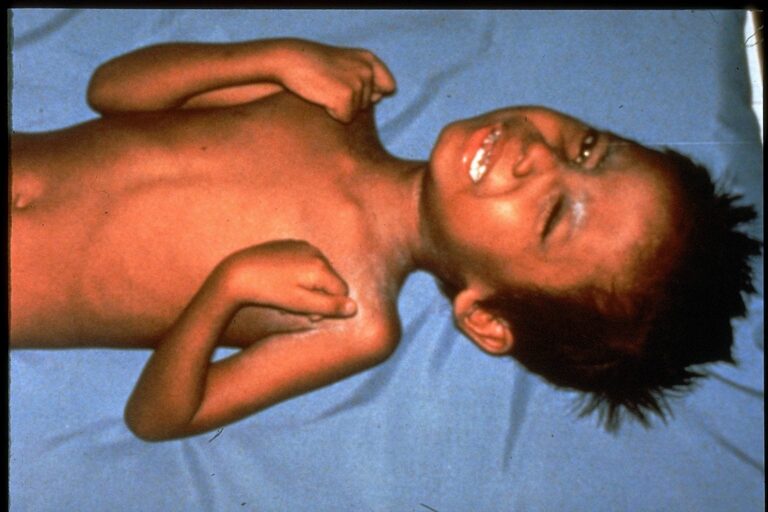
Symptoms of Tetanus also depend on age group. For adults and older children, it may first present as locked jaw where they affected person can not open their mouth. Later, they begin to have muscle spasms. Spasms is the hall-mark symptom of Tetanus in most age groups. It looks like convulsion but can be described as sudden electric shocks which happen repeatedly. The spasms can affect all the muscles in the body.

Usually the child is conscious during these episodes of muscle spasms which are usually very painful. This muscle spasms can occur in any part of the body including the arms, legs, abdomen. The spasms tends to be triggered by things like noise, sudden movements and light.

Other symptoms of tetanus include difficulty in swallowing, headaches, fever, excessive sweating and convulsion (different from the spasm). The toxins can also affect others nerves in the nervous system known as the autonomic nervous system that regulate heart rate, blood pressure and breathing. This can lead to some patients with Tetanus ending up in Intensive care unit if very severe.

Symptoms of tetanus in babies usually start with refusal to suck. The babies with neonatal tetanus are usually irritable, crying before they start having the spasms.

Diagnosis of Tetanus

Most times, once the spasms occur it is very easy to make a diagnosis of tetanus. Tetanus is one of the easiest clinical diagnosis to make because the spasms are so peculiar to tetanus. In addition one can often easily spot the entry wound for the tetanus. In children, the wound is usually seen. Other sources of tetanus infections especially babies include the umbilical cord if covered with cow dung or cut with unsterilised and contaminated instruments. Chronic ear infection with pus can also be a source of the infection.

How is Tetanus treated?

Treatment of Tetanus involves

  • neutralizing the toxin
  • getting rid of the bacteria
  • symptomatic relief of the spasms
  • treating any other complications

Doctors neutralize the tetanus toxins using human tetanus immunoglobulin. Previously, we were using the horse ones antitetanus serum but now Human ones are being used which are safer. The immunoglobulin neutralize the toxins before they bind to the nerves and cause spasms.

Additionally, we get rid of the source of the tetanus bacteria spores by treating the wound, infected umbilical cord and ear infection. This may involve cleaning them out especially removal of dead tissues and by giving antibiotics treatment that the tetanus bacterium is sensitive to.

The spasms are managed by using medications that can relax the muscles.The most painful part of the tetanus is the muscle spasms which are painful, so muscle relaxant e.g. diazepam (valium) are given every four hours, frequently, in drip and bolus, to reduce the spasm and relax the muscles. Other symptomatic treatment are also necessary and in some cases may require ICU care.

Prevention of Tetanus

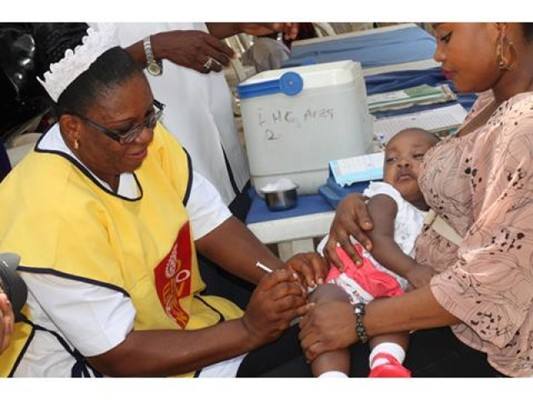
The most important and the best part is Tetanus is preventable. No child need to experience tetanus is one of the vaccine preventable disease. We have an effective vaccine against tetanus – the tetanus toxoid vaccine (TT)

In newborns, mothers have important role in preventing tetanus by ensuring that they are fully immunized against tetanus during pregnancy. There are five doses of the TT vaccine that all women of child-bearing age should take especially if living in areas where there clean deliveries supervised in hospital are not universal. See the timetable below

The main reason for immunizing the mothers is primarily because of the babies, even though the mother is also immunized. If a mother is immunized, her baby will be immunized.

In addition to immunization, mothers should ensure they deliver their baby in a standard hospital where deliveries take place in clean environment and sterilized instruments are used to cut the cord. Traditional birth centers often do not ensure such details.

Cord care is also important in preventing tetanus in the newborns. The navel is usually the entry point for tetanus in newborns. Cord care should be done by applying chlorhexidine gel once a day or using 70% methylated spirit every four hours to clean the cord. the navel should be exposed to air and not covered with bandages or nappies. Things like dusting powder, toothpaste, cow dung, mentholated balm and heat (wet or dry) should not be applied to the navel. Advantage of chlorhexidine gel is that mothers can just apply once a day for seven days, which is less stressful yet sufficient to protect the child from bacteria infection of the navel including that of tetanus bacteria. Where no gel is available, methylated spirit is fine but requires frequent cleaning every 4 hour. The cord care should continue the navel is fully healed. .

For older children, the main prevention from tetanus is routine immunizations. Tetanus toxoid vaccine is part of the routine immunizations given as part of the pentavalent vaccine (five in one vaccine) given at 6, 10, and 14 weeks. These three doses protect the children against tetanus until age 18 months. Then booster doses should be given at 18 months, 5, and 10 years because the initial protection tend to wane with time. Each time a child has a major injury or wound including burns; it is also prudent to give a booster dose of tetanus toxoid even though the child is fully immunized.

It is also important that the tetanus toxoid vaccine taken is well-kept to avoid break of the cold chain. Do not take the vaccine in just any clinic or hospital, as some facilities do not preserve their vaccines well due to lack of facilities and equipment to keep the tetanus vaccines in a cold environment, Hence government facilities are the best to go to for immunizations including that of tetanus toxoid as they always ensure the cold chain is not broken.

I hope you have learnt a lot about Tetanus. Feel free to ask your questions in the comments section or on our Facebook group. More importantly, ensure you and your children are fully immunized and protected against Tetanus.

Childhood Immunizations -The Benefits (1)

Childhood immunization is a major focus of Paediatrics practice.

Though adults also can be immunized, it is often voluntary or required for travel purposes.

However, in children, it is like a law. Indeed in most places, it is a punishable offence not to immunize your child.

Of course, parents always have lots and I mean lots of questions on immunization.

In fact, if you are going to be waken up from your beauty sleep as a Paediatrician by a new mum, apart from issues of colic, I think immunization comes a close second as the reason to.

Immunization is important! Immunization is life-saving! Childhood immunization is one of the most cost-effective public health initiatives ever!!!

In this article, I will explain briefly what immunization is, the benefits of childhood immunizations   the commonly available vaccines and the diseases they protect against.

What is immunization?

Immunization is the process by which an individual’s immune system becomes fortified or strengthened through the use of vaccines against some diseases.

What is Vaccination?

VACCINATION is the administration of vaccines to prevent specific diseases.

What is a Vaccine?

A vaccine is a preparation of killed microorganisms, living attenuated organisms, or part of living fully virulent organisms that is administered to produce or artificially increase immunity to a particular disease.

Is there a difference between Immunization and Vaccination?

Vaccination means the vaccine was given but the body immune system needs to respond appropriately for your child to be protected against the disease.

If a child gets the vaccine but his or her immune system for one reason or the other did not react by producing the antibodies that will protect you when you are exposed to the disease, you have only been vaccinated but not immunized.

Vaccination is necessary to have immunization. However, not every vaccination automatically leads to immunization.

This is very important as sometimes the vaccines given were not potent because there is a break in the cold chain to preserve it.

It could also be poor administration for example giving the BCG vaccine into the muscle instead of the skin. In those scenarios, the child has been vaccinated but not immunized. Sometimes, it is just some cross-reaction in the body system.

This may explain one of the questions Mums ask why their child still came down with a disease s/he has been immunized against. The child could have been vaccinated alright but not immunized.

Why should I immunize my child?

  • Immunization prevents between 2 and 3 million deaths every year in all age groups from diphtheria, tetanus, pertussis (whooping cough), measles, mumps and rubella.
  • An estimated 1.7 million children died from vaccine-preventable diseases in 2008 before reaching their fifth birthday.
  • Due to polio eradication efforts, over 8 million people are walking today who would otherwise be paralysed, and the incidence of polio has declined by 99.8%.
  • In Nigeria, for one year now, we have not recorded any single polio case.
  • Immunization prevents debilitating illness, disability and death from vaccine-preventable diseases.
  • Immunization is one of the most successful and cost-effective health interventions.
  • Vaccines have the power not only to save but also to transform lives ― giving children a chance to grow up healthy, go to school and improve their life prospect.

What are the available vaccines and what diseases do they protect against?

BCG – protects against Tuberculosis

Meningococcal vaccine (MCV) – protects against meningococcal disease.

Hepatitis B (HBV) vaccine – protects against Hepatitis B virus infection.

Oral Polio Vaccine (OPV) OR Inactivated polio vaccine (IPV) – protect against poliomyelitis.

DPT Vaccine–  This protects against diphtheria (D), tetanus (T), and pertussis (P) (whooping cough).

Hib Vaccine – protect againsts Haemophilus influenzae type bwhich causes spinal meningitis and other serious infections).

In Nigeria we now give DPT, HBV and HIB together as one vaccine called PENTA (means 5 vaccines in one preparation)

Measles Vaccine – protects against measles.

MMR (Measles, Mumps Rubella) vaccine – protects against measles, mumps and rubella (German measles).

Pneumococcal conjugate vaccine (PCV)  – protect against pneumonia, infection in the blood, and meningitis.

Another form of pneumococcal vaccine, PPSV (pneumococcal polysaccharide vaccine) is used in special conditions and in adults.

Varicella Vaccine – protects against chickenpox.

Rotavirus Vaccine – prevents infections caused by Rotavirus, most common viral cause of diarrhoea and vomiting in kids (RotaTeq or Rotarix)

Hepatitis A Vaccine – protects against Hepatitis A virus infection.

Human Papilloma Virus (HPV) vaccine – protects from Human Papilloma virus infection which is linked to cervical cancer and other cancers.

Seasonal influenza vaccine –  protects against different flu viruses.

These are the common vaccines available for children and the various diseases they protect against. The schedule (or timing) for giving these vaccines vary from one country to another.

Indeed it can vary from one hospital to another in the same country. The most important thing is to ensure that as parents, you take all the vaccines at the time specified in your Immunization Card or Chart. The one shared above is just a sample.

For the answers to commonly asked questions on childhood immunizations, click here to read answers to Common Questions on Childhood Immunizations.

You can also let me know your thoughts by dropping your comments below. More importantly, ensure that all your children are fully immunized so they are protected against the vaccine-preventable-diseases.