
INFANT FEEDING IN THE FIRST 1000 DAYS

Infant feeding especially, in the first 1000 days of a child is very essential!!

Our instincts as moms to nourish, nurture and protect our children from the moment we become aware of their existence actually has a scientific basis.

The first 1,000 days of a child’s life—from pregnancy (270 days) through a child’s 2nd birthday (365 days x 2) serves as a critical window of time that sets the stage for a person’s intellectual development and lifelong health.

It is a period of enormous potential, but also of enormous vulnerability.

Ensuring every child has the right start to life during these precious 1,000 days begins first and foremost with nutrition. The nutrition that children get from the food they eat early in life is a critical building block for the growth of their bodies, the development of their brains, and good immune systems.

Quite simply, there is no other period of a person’s life when nutrition has as profound an impact as in the 1,000 days from a woman’s pregnancy until her child’s 2nd birthday.

Poor nutrition or malnutrition, which can be under-nutrition (hunger) or over-nutrition (obesity) early in life can have long-lasting negative consequence on the child some of which may be irreversible. This is the reason why ensuring good nutrition for the first 1000 days of life is a worthy investment in the well-being of a child.

What does good nutrition in the first 1000 days entails?

Pregnancy period : Maternal nutrition

The pregnant mom must eat healthy, adequate nutritious diet including taking prenatal vitamins especially folic acid which is very important for brain development of the baby in the first trimester of the pregnancy.

0 – 6 months : Exclusive breastfeeding  

  •  As soon as the baby is born and for the next six months of baby’s life, exclusive breastfeeding.
  • That is giving baby only breast milk in the first six months! No water, no formula, no herbal concoction, no medications except if prescribed by the doctor.
  • Breast milk is very good for growth of the baby and also for good brain development. It is the most powerful protection against infection and disease that a child could get not forgetting a host of other benefits for both mom and baby.

6 – 24 months : Complementary feeding

  • From 6 months, breast milk is no longer sufficient. The infant should be introduced to solid foods while continuing breastfeeding on demand.
  • The solid should not just be one class of food for example pap but a mix of all the various classes of food including proteins, fats, vitamins and minerals. This is vital for growth and brain development.
  • To be sure that you are doing the complementary feeds right, the practice must fulfill this acronym: FADUA!
  • F – Frequency
    • The frequency of complimentary feeds given in a day increases with the age of the child. Usually about 2 – 3 times a day in 6 – 9 months, then 4 times per day after 9 months. Remember breastfeeding should still continue till age 2 years while infants are on complementary feeds

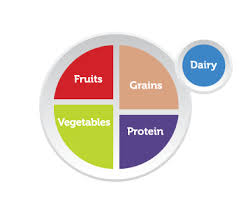
      My Plate Photo credit: Google Image
  • A – Adequate
    • This means adequacy of the food in quantity and quality. It should contain foods from at least four of the six food groups which includes a) grains, roots and tubers b) legumes and nuts c) dairy products (milk, yoghurt, cheese) d) Flesh foods (meat, fish, poultry and liver/organ meats) e) Eggs f) Fruits and vegetables
  • D – Density.
    • This has to do with the consistency and caloric density of the complimentary feed. The consistency should be appropriate for age in order to ensure easy digestion by the infant. Foods with high calorie content are preferred.
  • U – Use of food.
    • This entails use of a variety of foods so as to avoid monotony as infants often get bored with being given the same type of food all the time. It also involves use of hygienic methods of feeding, food preparation and storage. Always give variety and use of plates, cup and spoon! Do not use feeding bottles please.
  •  A –  Active feeding methods.
    • This is also known as responsive feeding and is defined as the process of recognizing baby’s cues for hunger and fullness and responding appropriately to them by either feeding or stopping. Force feeding should not be practiced.

By the end of age 2 years, the child should be on full family diet like the rest of the family. It is important that we get the nutrition in the first 1000 days of life right. Make that worthy investment today!

In subsequent series, we will look at the practical details of feeding and the nutritional disorders and their consequences. Keep reading.